The immortal jellyfish, Turritopsis dohrnii, can reverse part of its life cycle and return from a swimming medusa to a polyp stage. That remarkable ability explains its nickname. It does not mean every individual survives forever or cannot die.

What does the immortal jellyfish look like?

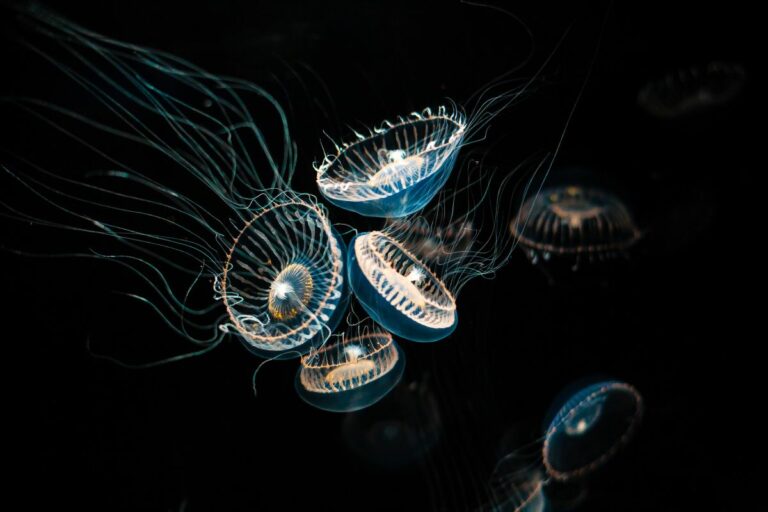
Adults are only about 4–5 mm across, with a transparent bell and a conspicuous reddish stomach. Their small size makes them easy to overlook and difficult to identify confidently from a casual photograph.
Turritopsis is a group of hydrozoans. Do not assume every small jelly with a red stomach is T. dohrnii, or that every similarly named species has identical regenerative abilities. Our jellyfish guide introduces the wider variety of animals called jellies.
What happens during life-cycle reversal?
The usual cycle includes a larva, an attached polyp colony and medusae that bud from that colony. Under conditions such as injury or starvation, a medusa can lose its swimming form and reorganise into an attached stage from which polyps develop.
The American Museum of Natural History explains this reversal. The resulting colony can produce new medusae genetically matching the original animal. The process is more substantial than an adult simply shrinking into a miniature adult.
Cellular reprogramming, including changes in cell identity described as transdifferentiation, is central to the research. That term does not mean time itself runs backward or that every original cell must be replaced with a brand-new cell.
Does it really live forever?
“Biological immortality” describes the potential for repeated rejuvenation, not a documented animal that has already lived an infinite life. Predation, infection and unsuitable conditions can still kill these jellies.
The Institute of Marine Sciences’ account, featuring researcher Maria Pascual-Torner, makes this distinction explicit. Reversing development is an extraordinary survival mechanism, not immunity to every threat.
It also does not establish a conservation category. A species’ extinction risk depends on population and habitat evidence, rather than whether an individual can rejuvenate.
What have genetic studies found?

A 2022 comparative genomics study examined T. dohrnii and T. rubra, alongside gene activity during reversal. Researchers identified differences involving DNA repair, telomere maintenance and cellular plasticity.
These are candidate mechanisms to investigate, not proof that the jellyfish has “twice as many protective genes” in every sense, or that all its cells are protected from aging and damage. Gene copy number, gene activity and demonstrated biological function are different measurements.
Where is it found?
The species was described from the Mediterranean, but its present distribution extends beyond that region. The Smithsonian’s NEMESIS database records introduced populations including Florida, Panama and Japan, and notes that the attached hydroid stage can occur on docks, pilings and ship hulls.
Transport on vessels is a dispersal route; it should not be turned into a claim that the jellyfish can survive any ballast-water treatment. Never release cultured marine organisms into local waters.
Why researchers study it

The species offers a way to study how animal cells change identity and how a body can rebuild an earlier developmental stage. Those questions are valuable without promising human immortality or an established anti-aging treatment.
For the distinction between sexual reproduction, cloning and developmental stages, see how jellyfish reproduce. Rejuvenation and producing offspring are related parts of this animal’s biology, but they are not interchangeable terms.