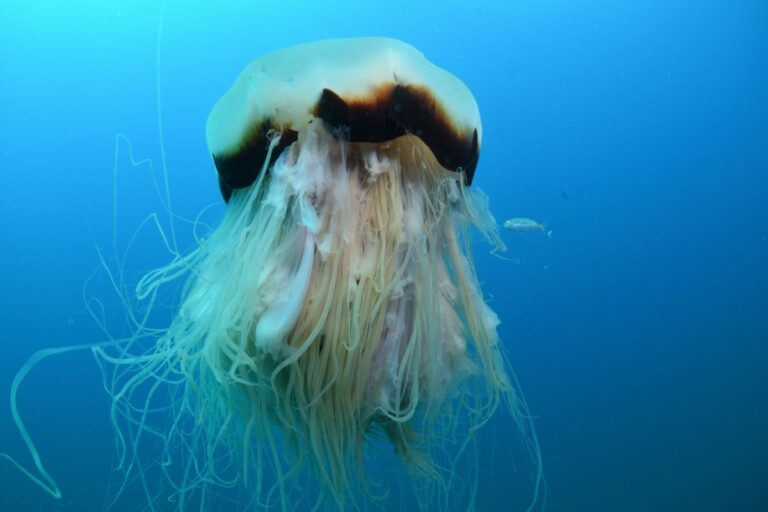
Barrel jellyfish are large, thick-bodied jellies recognised by a broad bell and eight frilled oral arms. They lack the long marginal tentacles seen on lion’s mane jellyfish. The common name can refer to closely related Rhizostoma species, so location matters when identifying one.

Which species is a barrel jellyfish?
British barrel jellyfish are generally identified as Rhizostoma octopus. Rhizostoma pulmo, common in Mediterranean accounts, is a separate species. Older guides and image labels sometimes use the names inconsistently.
MarLIN’s species account distinguishes the two using features including the bell’s marginal lobes and the proportions of the oral arms. A broad colour description or a distant beach photograph may not resolve the species.
Appearance and size
The bell can be whitish, bluish or otherwise pale, with a coloured margin. Below it hang four pairs of substantial, branching oral arms. These are feeding structures, not eight octopus-like limbs.
MarLIN reports a bell diameter reaching about 90 cm for R. octopus. The Marine Conservation Society describes exceptional barrel bells approaching a metre. These are large specimens, not the size of every animal.
“Largest” also depends on what is measured. Bell width, weight and total tentacle length are different comparisons; a barrel jellyfish does not hold every jellyfish size record. Compare forms in our jellyfish identification guide.
Habitat and seasonal sightings

R. octopus occurs in north-east Atlantic waters, including around Britain and Ireland. Animals can aggregate in bays but also occur in open water. Mediterranean photographs labelled R. pulmo should not automatically be used as records of the British species.
The Marine Conservation Society’s barrel jellyfish profile describes frequent coastal sightings and an Irish Sea hotspot in spring and summer. Local conditions affect when and where animals gather.
Jellies pulse their bells but are also influenced by currents. Stranding is not evidence that they “underestimated their size” or consciously chose water that was too shallow.
Feeding and ecological role
Barrels feed mainly on small plankton captured around their complex oral arms. Their feeding anatomy differs from the long trailing tentacles of many familiar jellies.
They are also food for other marine animals, including leatherback turtles. A large, gelatinous body does not remove an animal from the food web.
Life cycle
Like other scyphozoan jellies, barrels have more than the visible swimming stage. The general cycle includes a larva, an attached polyp and young swimming ephyrae that grow into medusae. Polyps can reproduce asexually, while mature medusae produce sexual offspring.
Monterey Bay Aquarium explains these life stages; our jellyfish reproduction guide covers the terminology. A lifespan quoted for a swimming medusa should not be assumed to describe the entire polyp-to-medusa history.
Observe without handling
Barrel jellyfish have a generally mild sting, but mild does not mean harmless to touch. Avoid handling living animals, stranded jellies and detached material. The Marine Conservation Society cautions that they can still sting after death.
Photograph from a safe distance and record the location and date if contributing a sighting. This is a wild-animal profile, not a recommendation to collect a large jellyfish for a home aquarium.