Detectable nitrite in a stocked freshwater aquarium is a water-quality problem to address promptly. Test the water, improve aeration, check the biological filter, and dilute nitrite with suitable replacement water. Do not deliberately leave nitrite present to “feed the bacteria” while fish remain exposed.

Why nitrite harms fish
Nitrite interferes with the blood’s ability to transport oxygen by converting hemoglobin to methemoglobin. This can produce brownish blood and breathing distress. That mechanism belongs to nitrite toxicity; it should not be confused with nitrate accumulation.
Rapid breathing, surface hanging, lethargy, and appetite loss are possible signs, but they do not identify nitrite by themselves. Test ammonia and nitrite and check temperature and aeration. Seek an aquatic veterinarian promptly for severe or persistent distress.

What to do after a positive test
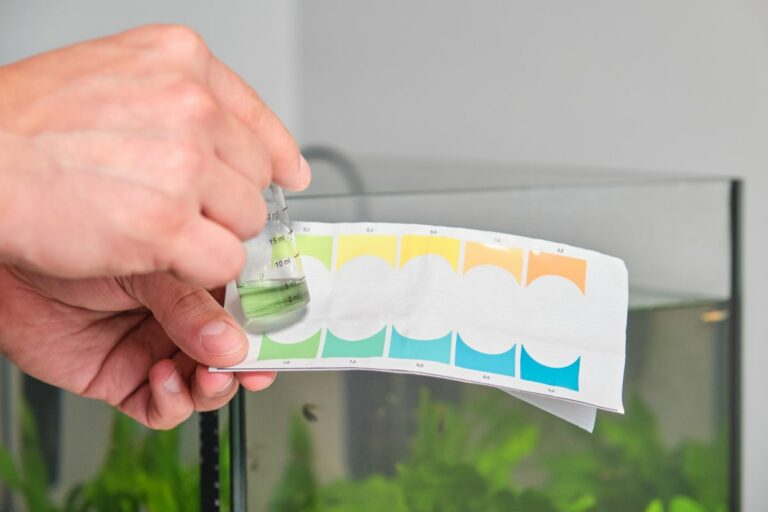
- Confirm the reading using the kit’s instructions. Note whether it reports nitrite as NO2− or nitrite-nitrogen; the numbers are not interchangeable.
- Check source water, then make an appropriate partial change with conditioned, temperature-matched water. A substantial change may be needed for a significant spike; retest rather than assuming one change solved it.
- Increase aeration without creating an excessive current for the fish. Keep the filter operating and check for blocked flow.
- Remove dead animals and decaying food. Adjust feeding temporarily to actual consumption and fish condition so leftovers do not add more waste.
- Monitor ammonia and nitrite until both remain undetectable under the normal stocking and feeding load.
Aeration supports the fish and biofilter but does not remove nitrite. Antibiotics or parasite treatments do not correct the underlying filtration problem.
Find the reason for the spike
Common triggers include an unfinished cycle, a sudden increase in stocking or waste, filter failure, or loss of established filter media. Nitrite can rise after ammonia has already begun falling. Review the nitrogen cycle and biological filtration rather than repeatedly replacing filter cartridges.
Healthy established media from a disease-free system may help restore capacity, but introduces biosecurity considerations. A bottled culture is not proof the aquarium can process its load; testing remains necessary.
Should you add salt?
Chloride can reduce nitrite uptake at the gills, but an appropriate response depends on species, existing chloride, measured nitrite, and other occupants. Do not apply a universal tablespoon-per-tank dose. Salt does not remove nitrite and cannot replace dilution and biofilter recovery.
What changes in a marine aquarium?
The much higher chloride concentration in seawater reduces nitrite uptake, so freshwater toxicity assumptions cannot be transferred directly. A marine nitrite result can still indicate an immature or disrupted system. Check ammonia and overall water quality rather than declaring every marine animal unaffected.
Prevent another spike

Establish the filter before stocking, add fish gradually, preserve mature media, and follow a consistent maintenance routine. Live plants can take up nitrogen as they grow, but are not an emergency antidote or a guarantee against nitrite.
Sources: Vetofish: nitrite toxicity and immediate response; Merck Veterinary Manual: environmental disease and nitrite.