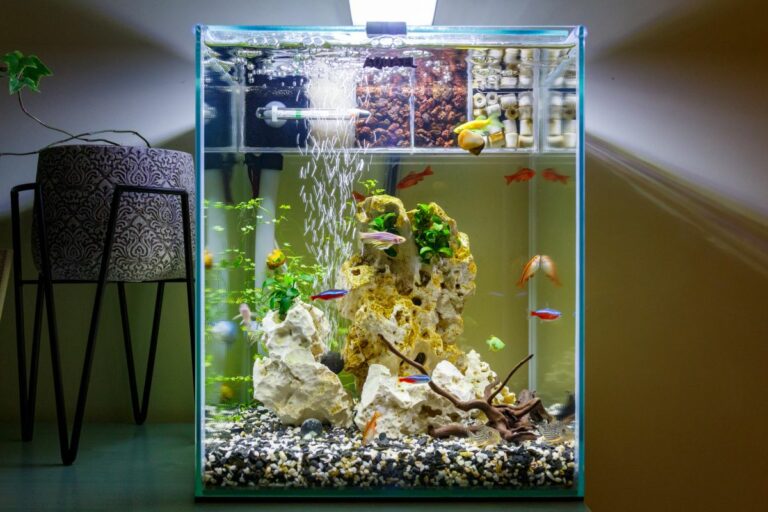
An aquarium air stone breaks pumped air into bubbles. The rising bubbles move water and disturb the surface, helping gas exchange. It is useful when extra aeration is needed, but it is not compulsory in every adequately circulated aquarium and does not replace filtration.

Choosing a stone and pump
Match the stone’s airflow and pressure requirements to the pump at your tank’s actual depth. Pump wattage alone does not establish compatibility. Long bubble bars and fine-pore discs may need more pressure than a small ordinary stone.
Consider noise, replacement parts, tubing size and ease of cleaning. The densest-looking cloud is not a measurement of dissolved oxygen. Warm water, stocking, surface movement and biological activity affect oxygen demand; investigate gasping rather than assuming a new ornament solves the cause.

Installing and positioning the equipment
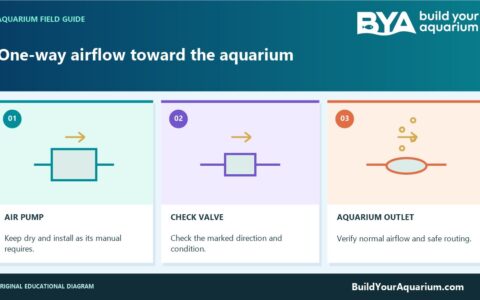
Follow the pump and diffuser manuals, including any pre-soaking requirement. Keep a non-submersible pump dry and protect it from back-siphoning. Tetra’s APS manual explains the use of a check valve when the pump is below water level. Install valves in the correct flow direction and use drip loops on electrical cords.
Place the diffuser where it creates useful circulation without forcing fish into a strong current. Keep its surface unobstructed unless its manufacturer specifically permits burial. Avoid sending bubbles directly into a filter intake that is not designed to ingest air. An air stone inside an air-driven sponge filter is a different, intended arrangement.

Common product styles
The examples below illustrate designs to compare. Confirm the current model, included parts and instructions before buying; photographs and old kit descriptions do not establish present specifications.
Hygger air-stone kits

Fine-bubble discs can require particular pumps and initial soaking. Check Hygger’s model-specific information, rather than assuming every kit includes tubing and a pump or fits every airline size.
Pawfly bars

A bar creates a line of bubbles. Check its length against the available space and its airflow requirements against your pump. Multiple outlets may need a suitable manifold and individual control.
NICREW illuminated discs

Illumination adds a separate electrical component. Confirm the adapter and installation requirements. The lighting function does not supply air or establish oxygenation performance.
UPETTOOLS diffuser kits

Check mounting hardware and the purpose of each supplied valve. A flow-control valve and a one-way check valve perform different jobs and should not be confused.
AQUANEAT discs

Simple discs can be sufficient for routine aeration. Compare the actual size and required airflow instead of assuming a multi-pack is compatible with every aquarium or pond.
Aqueon flexible LED bubble wands

Flexible wands can follow a layout, with lighting and air delivery operating as separate functions. Follow Aqueon’s installation instructions. Keep the aquarium’s dark period even if the decorative lights can run all night.
Volcano and other bubbler ornaments

Decorative housings need space and cleaning access. Inspect openings for trapping hazards and confirm that the air outlet remains clear. An ornament is not automatically more or less efficient merely because of its appearance.
Cleaning and troubleshooting

If output falls, inspect kinks, loose connections, valve direction, pump wear and clogging. Clean the diffuser according to its own instructions. A generic bleach soak followed by a few hours of drying is not proof that every porous stone or electronic ornament is safe to return.
Replace damaged or persistently blocked parts. There is no universal six-week expiry date. Never mix cleaning chemicals, and keep cleaners away from livestock.
Aeration can change pH by changing dissolved CO2; it is not an automatic correction toward neutral pH. For setup and troubleshooting, see the aeration guide, and coordinate use with any CO2 injection system.