

Lower aquarium pH only when the current water is unsuitable for the fish you keep. First measure pH, KH, and GH in the tank and source water. Otherwise, a pH-lowering product may produce a temporary drop followed by another rise.

Find out what is holding pH high
Check the tap or other refill water, carbonate-rich rock and substrate, and any buffers already added. In planted tanks, account for the daily effect of CO2 use and lighting. Compare readings taken at the same time.
KH indicates the water’s resistance to acid-driven pH changes; GH measures calcium and magnesium. They are not interchangeable. Our pH explanation covers the distinction.
Prepare suitable replacement water
If the source water is poorly matched to the livestock, a repeatable replacement-water method is more useful than repeatedly correcting the tank. RO or deionized water can be part of that method, but it needs appropriate remineralization or a planned blend for the animals being kept.
Do not assume that pure RO water has a fixed pH or provides everything freshwater fish need. Measure the prepared water’s hardness, buffering, pH, and temperature. Keep the recipe consistent and introduce it through a controlled water-change plan.
Aqueon’s water-care guidance discusses restoring minerals and buffers when using RO/DI water. A water conditioner removes specific disinfectants; it is not a substitute for mineral preparation.
Understand the limits of driftwood and peat
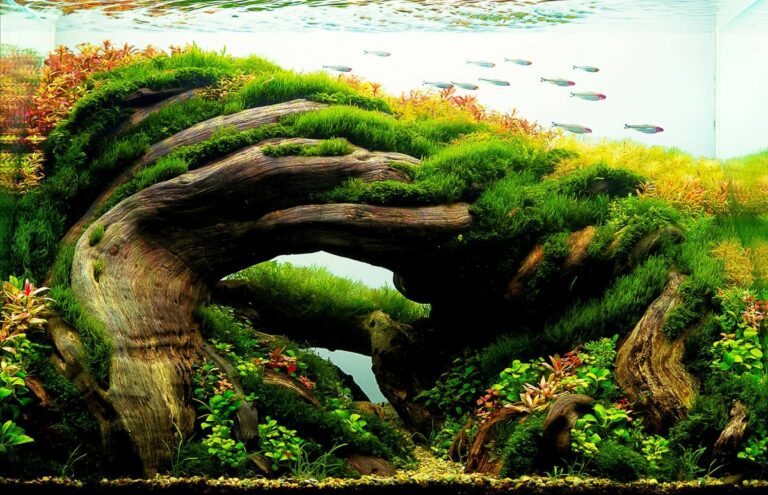
Driftwood and aquarium peat can release compounds that influence pH, but their effect depends on the material, quantity, and buffering. A piece of wood is not a predictable acid dose, and brown water does not prove that pH has fallen.
If using peat, choose a product intended for aquariums, contain it appropriately, and monitor the results. Avoid garden peat containing additives. Leaves and botanicals also vary; do not treat a leaf-per-gallon formula as a guaranteed pH setting.
Use pH-adjusting products only as directed
Check the product’s purpose, compatibility, and instructions. Test the water rather than assuming the same dose will work in every tank. Repeatedly adding more because the pH rebounds can cause increasingly unstable conditions.
A CO2 system is equipment for managing plant growth, not a general-purpose solution to high pH. Raising CO2 solely to force the reading down can put animals at risk. Likewise, do not switch off aeration to retain CO2 without understanding the consequences.
Monitor the transition
Plan adjustments before stocking wherever possible. In an occupied aquarium, avoid sudden changes and get advice suited to the species and measured water chemistry. There is no single safe rate of change that covers every situation.
Track the broader water parameters and the fish’s behavior during the transition. Keep a consistent maintenance routine; topping off evaporation alone does not replace water changes or remove accumulating waste.

Great article! I have those bubbles around my plant leaves but it gets so crazy that it turns into foam! So much that you could top off a cappuccino with it! But I’m trying to work with all these chemicals, as this is all new to me.