The North American wood turtle, Glyptemys insculpta, needs substantial space on land as well as access to clean water. It is a long-lived, active turtle, not a species to choose because a young animal fits in an aquarium.

Identification and adult size
Adults usually measure about 5–9 inches (13–23 cm) in shell length. The brown upper shell has a sculptured surface, with raised scutes and growth rings. Orange, yellow or reddish skin around the neck and legs contrasts with the darker head.
The Connecticut DEEP species profile describes these identification features. A wood turtle does not have the closing, hinged lower shell of a box turtle. Do not use swimming behavior alone to identify either animal.
Plan for decades of care. These turtles mature slowly, and removing breeding adults can have lasting effects on a wild population.
Wild habitat and seasonal behavior

Wood turtles occur in parts of the northeastern and north-central United States and eastern Canada. Their habitat includes streams and the surrounding woodland, meadows and other land used for feeding and nesting.
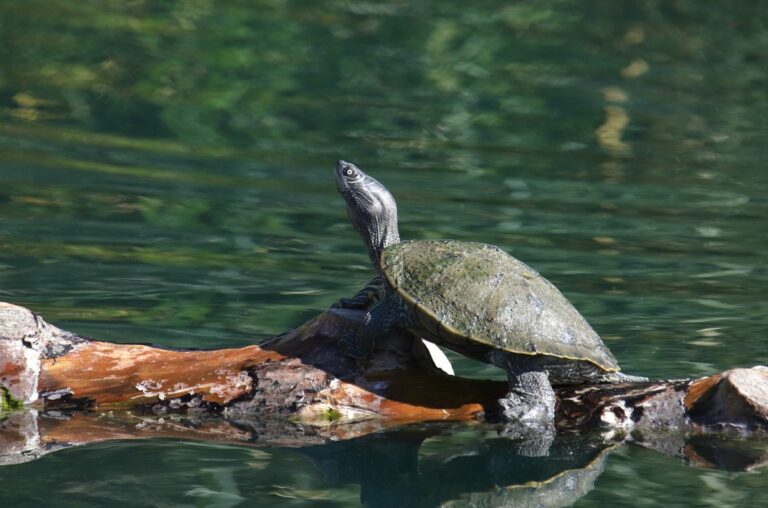
They are neither strictly aquatic nor strictly terrestrial. How much time they spend in each habitat changes with season and conditions. The US Fish and Wildlife Service profile explains why protecting both habitats matters.
They overwinter in water in the wild, but that is not a home brumation recipe. Do not put a captive turtle outside in cold weather or cool an indoor enclosure without an experienced reptile veterinarian’s plan.
Enclosure: think pen and pond

An adult needs a broad enclosure with usable ground, shelter and a water area it can enter and leave easily. A small aquarium divided between a dock and water provides little room for walking or foraging.
In their firsthand husbandry account on Austin’s Turtle Page, keepers describe an outdoor pen of about 5 × 5 feet for one adult, with a substantial pond. Treat that as a planning reference rather than proof that every pen of those dimensions is suitable. Climate, shade, water access and escape prevention still matter.
Provide planted or covered areas, pesticide-free digging substrate, sheltered retreats and an accessible dry basking area. Secure walls and overhangs must prevent climbing out, while outdoor protection must also account for local predators.
Water depth must suit the animal’s size and ability. Include resting places and gradual exits rather than a steep-sided pool. A young or weakened turtle needs different access from a strong adult. Secure heavy decoration so it cannot collapse or trap the animal.
Use filtration and test the water instead of relying on appearance. Read our guides to cycling a turtle enclosure and routine turtle tank cleaning before stocking it.
Temperature, shade and UVB
This is not a tropical turtle to keep uniformly hot. Provide cooler retreats and prevent the water and land area from overheating, especially in an outdoor enclosure. Shade must remain available as the sun moves.
The keeper account above uses air around 70–80°F (21–27°C), a basking area near 85°F (29°C), and cooler water around 60–70°F (16–21°C). These are reference conditions for planning an adult enclosure, not instructions to chill an unwell animal or impose a winter cycle.
Indoors, provide appropriate UVB alongside a measured basking gradient. Lamp distance depends on the particular bulb, reflector and screening; a universal 12-inch rule is unreliable. Our UVB lighting guide explains the practical checks. Damp sheltered substrate and ventilation are more useful than trying to maintain one high humidity reading throughout the enclosure.
Diet

Wood turtles eat both animal and plant foods. Suitable invertebrates, such as earthworms from safe sources, can be offered alongside appropriate greens, other plant foods and a suitable formulated food. Use a varied, planned diet rather than whatever the turtle accepts most enthusiastically.
Fruit can add variety but should not crowd out the rest of the diet. Do not assume every turtle over one year old needs 75% vegetables, and do not use bare muscle meat or dried shrimp as a complete staple. Adjust portions to age, activity and body condition; discuss supplements with a reptile veterinarian.
Compatibility and conservation
Housing one animal avoids mating pressure and many conflicts. A mixed group can still fight even with only one male. Do not assume other turtle species are safe companions simply because their adult size is similar.
Habitat loss, road mortality and collection threaten wild wood turtles. Conservation categories and possession rules vary by jurisdiction. Check current requirements before any acquisition and obtain documented, lawful animals; leave wild turtles in their habitat. Never release a captive turtle into the wild.