A white crust collects on the rim, tubing or overflow above a reef tank. It is easy to dismiss it as a cosmetic nuisance. Salt creep is also a reason to check where water is splashing or escaping and whether nearby equipment is staying dry.
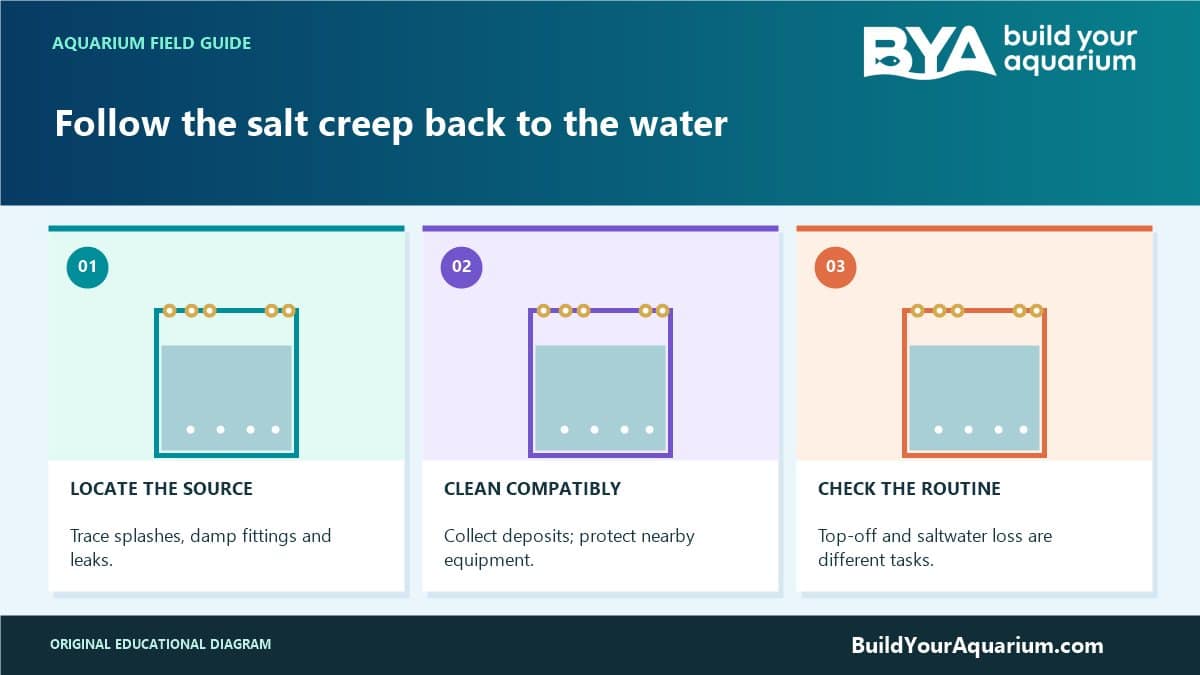
Find the wet path before wiping it away
Droplets or a thin film of saltwater can leave salt behind as the water evaporates. Inspect the deposit’s position. Is it beside a bubbling return, a poorly seated lid, a fitting or a damp seam? A recurring trail deserves attention at its source.
Do not assume every white mark is the same material. Mineral scale, dried salt and other deposits can look similar from a distance. Investigate unusual leakage rather than treating repeated wiping as the entire repair.
Bulk Reef Supply includes salt-creep removal in routine reef maintenance, particularly around the rim, overflow and sump. Small, accessible deposits are easier to manage than a heavily crusted fitting.
Remove it without scattering it into the display
Follow the equipment manufacturer’s shutdown and cleaning instructions. Keep water and cleaning materials away from electrical connections. If a plug, socket or powered component is wet or heavily contaminated, address that condition before routine cleaning.
For suitable accessible surfaces, a clean damp cloth can soften and collect salt. Avoid knocking a concentrated lump onto animals below. Removable parts can be cleaned separately with a method compatible with their materials, then rinsed and reassembled as instructed.
Household spray cleaners and random descalers do not belong in the aquarium. Use the broader maintenance guide to organize work without contaminating the water or disrupting biological filtration.
Keep salt loss separate from evaporation
Evaporated water leaves its dissolved salts behind. Saltwater lost through a leak, spill or heavy wet skimming is different. A top-off system cannot identify every cause of a falling level or independently correct salinity.
Check salinity with a reliable instrument, inspect the reservoir and sensor, and keep the intended operating level consistent. The ATO guide explains why placement and safeguards matter.
After cleaning, photograph or note where the crust appeared. If it returns quickly in one place, investigate the water path. The useful result is a controlled system, not just a clean-looking rim.