Your refractometer gives one salinity reading and another instrument gives something different. Before adding freshwater or salt, verify the measurement. Correcting the aquarium around a faulty reading can turn an instrument problem into a real water-quality problem.
Check the scale and the calibration method
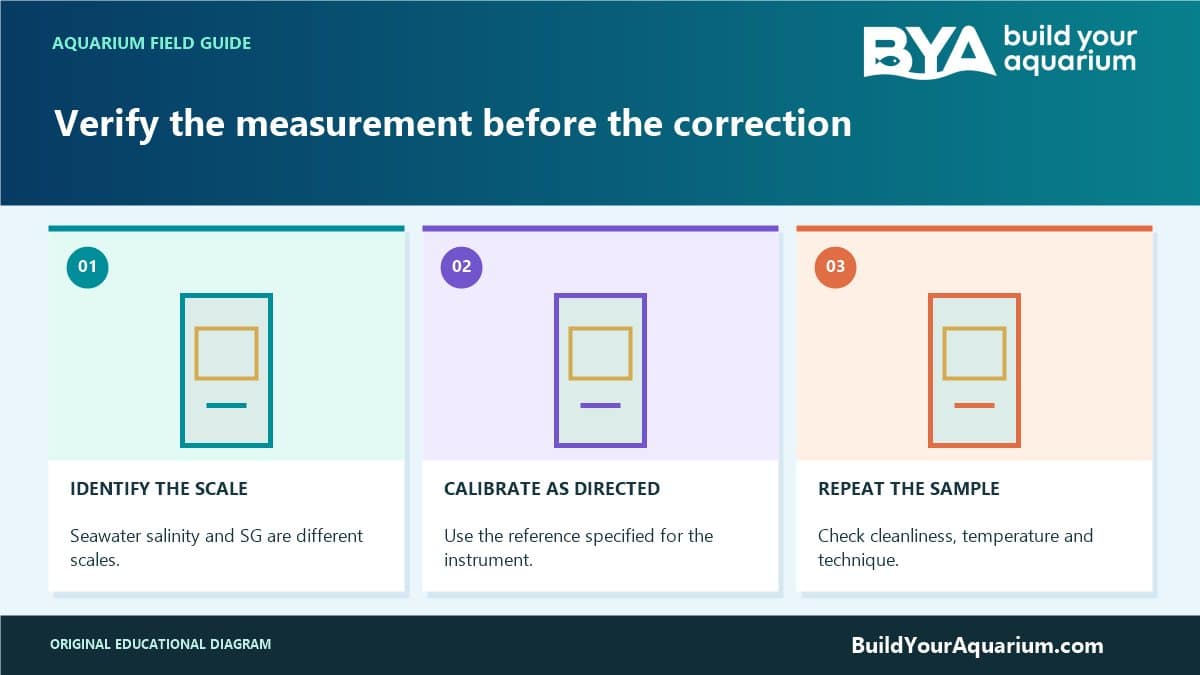
Salinity in parts per thousand and specific gravity are related, but they are not interchangeable numbers. Make sure you are comparing the intended scales under the conditions specified for both instruments.
The Red Sea seawater refractometer manual also distinguishes a seawater instrument from one calibrated for a simple brine solution. The sample composition matters to what the scale represents.
Follow the exact model’s calibration instructions. That Red Sea manual specifies DI water for its zero-point calibration and gives temperature and equilibration directions. A different manufacturer may specify an appropriate reference solution. “Use the same liquid for every refractometer” is not a substitute for the manual.
Prepare a clean, representative sample
Clean and dry the measuring surface as directed. Old salt residue, an incompletely covered prism or a sample that has not reached the required conditions can complicate the result. Allow the instrument and sample to equilibrate for the time its instructions require, then read under suitable lighting.
Repeat with a fresh sample from a well-mixed part of the system. Avoid taking one measurement immediately beside a freshwater top-off outlet and comparing it with water from elsewhere before mixing has occurred.
Use agreement as evidence, not a vote
Two unverified instruments do not become a reference simply because you average them. If results still disagree after correct preparation and calibration, check with an appropriate known standard or a reliably maintained reference instrument. Record the method and units alongside the number.
Our water-parameter guide explains why a test result needs context. Keep the aquarium’s actual inhabitants and chosen operating range in mind rather than treating a shop’s display value as a universal target.
Once you have a dependable reading, plan any necessary change deliberately. The reef salt guide covers preparing and comparing replacement mixes. Verify the replacement water too; a calibrated instrument is useful only when the sampling routine is equally dependable.