The best reef salt is one that mixes consistently near your aquarium’s intended parameters, is available reliably and fits your maintenance budget. There is no universal winner for every reef, and a higher calcium or alkalinity number is not automatically better.
Choose by the water you intend to maintain
Compare alkalinity, calcium and magnesium at the same final salinity. A specification measured at a lower salt concentration is not directly comparable with one measured at 35 parts per thousand.
Consider the aquarium’s current values and consumption. A high-alkalinity replacement mix can cause an unwanted jump in a lower-alkalinity reef during a large water change. Changing brands does not remove the need to measure or supplement elements that corals consume.
Salt mixes worth comparing
| Mix | Useful distinction | What to check |
|---|---|---|
| Instant Ocean Sea Salt | A general marine mix; distinct from Reef Crystals | The actual batch’s parameters and local cost at your intended salinity |
| Red Sea Salt | Marketed around moderate alkalinity, approximately 8 dKH | Whether its specified mixing conditions and chemistry fit your reef |
| Red Sea Coral Pro | Higher-alkalinity formulation, approximately 12 dKH | The effect of a water change on the aquarium’s existing alkalinity |
| Tropic Marin Pro-Reef | Designed around a 7–8 dKH alkalinity range | Compatibility with your supplementation and maintenance plan |
| Brightwell NeoMarine | A complete marine mix aimed at natural-seawater proportions | Exact product identity; Kalibrate premix is not the same ready-to-use blend |
These distinctions come from Instant Ocean’s product information, Red Sea’s salt comparison, Tropic Marin Pro-Reef specifications and Brightwell’s NeoMarine guidance. They are a comparison of formulations, not a claim of independent laboratory superiority.
Do not assume a premium mix guarantees coral growth or that an inexpensive one must contain harmful impurities. Evaluate actual preparation, measurements, batch support and livestock response.
Calculate cost per usable gallon
Compare delivered prices using the same target salinity. A box labeled for a particular number of gallons may use a lower reference salinity than your reef. Include shipping, source-water production and any storage equipment.
A locally available mix you can prepare consistently may be more practical than a nominal bargain with unreliable supply. Keep the package sealed and dry, record the batch number and ask the manufacturer about suspicious contamination or damaged packaging.
Mix replacement water correctly
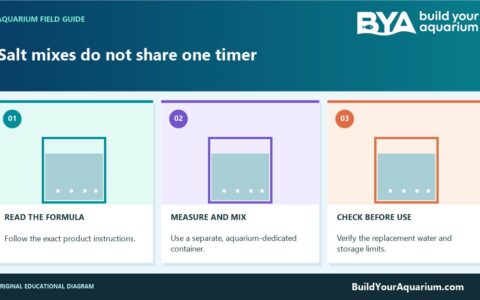
- Use a clean, aquarium-dedicated container and a suitable purified freshwater source.
- Follow the exact mix’s instructions for starting temperature, circulation and order of addition.
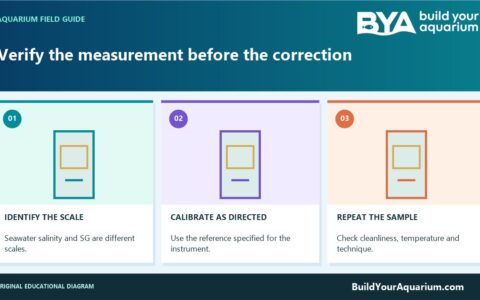
- Measure the salt as directed, then verify final salinity using a calibrated instrument.
- Allow the required dissolution and mixing time; do not assume every brand needs either 15 minutes or 24 hours.
- Check temperature and relevant chemistry before the water reaches livestock.
Never mix dry salt directly into a stocked aquarium. A general reef often operates near natural seawater salinity, but use the requirements of the actual animals and distinguish salinity units from temperature-dependent specific gravity.
Keep top-offs separate from water changes
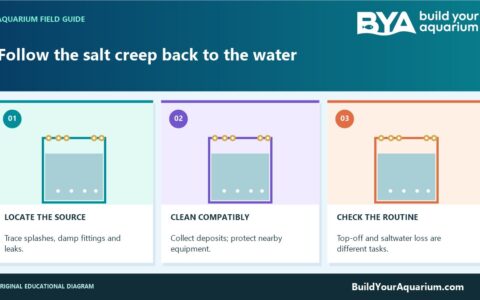
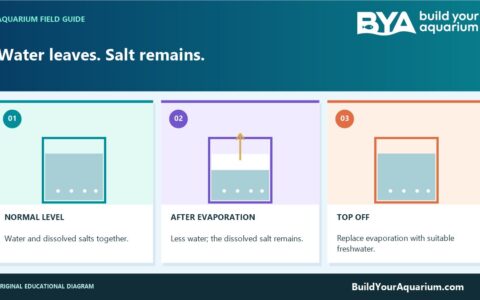
Replace ordinary evaporation with suitable freshwater because the salt remains behind. Replace removed saltwater with properly prepared saltwater. Confusing these jobs can steadily raise or lower salinity.
For the wider routine, see aquarium maintenance and common saltwater aquarium mistakes. A consistent water-change process matters more than repeatedly changing salt brands in search of a shortcut.