Fish reproduce in several ways. Many release eggs and sperm into the water for external fertilization; others fertilize eggs internally and give birth to live young. Some guard nests or carry developing eggs in their mouths. The method depends on the species.
Finding a partner
Color, body shape, fin shape and courtship behavior can help identify sexes, but none is a universal rule. A colorful or aggressive fish is not automatically male. Female convict cichlids, for example, can show an orange-red belly.

Use a species-specific identification guide and mature animals. Young fish may not show reliable differences, and chasing can indicate aggression rather than successful courtship.

Egg laying and external fertilization
In many aquarium fishes, the female releases eggs while the male releases sperm nearby. Some scatter eggs among plants or over the substrate; others attach eggs to a surface. Eggs may be adhesive, nonadhesive, floating or sinking.
Egg placement and parental care are separate traits. A fish can lay eggs on a surface and guard them, or deposit them and leave. Freshwater angelfish are surface spawners with parental care; they should not be grouped with marine broadcast-spawning angelfishes simply because their common names match.
Egg scatterers
Danios and many barbs and tetras scatter eggs without subsequently guarding them. Adults may eat their eggs. The ZFIN zebrafish breeding protocol describes protecting newly spawned eggs from the parents; its laboratory setup is an example, rather than a universal recipe for aquarium fish.
Surface and nest spawners
Clownfish lay adhesive eggs on a suitable surface. Many cichlids lay on leaves, rocks or inside shelters, while some bettas and gouramis build bubble nests. Nest design, which parent guards it and when adults should be separated all require species-specific advice.

A betta bubble nest alone does not prove mating occurred. Breeding fish can injure a prospective partner, even if their display initially appears normal.

For freshwater angelfish, read the angelfish care guide before preparing a breeding setup. A pair guarding eggs can become territorial toward its tank mates.
Mouthbrooding
Some fish incubate eggs in the mouth. The brooding parent can be male or female depending on the species: many African cichlids are maternal mouthbrooders, whereas Banggai cardinalfish use paternal care.
Georgia Aquarium describes the male Banggai cardinalfish carrying the eggs. Mouthbrooding provides protection, but does not guarantee survival. Avoid disturbing a brooding fish or attempting to strip eggs without appropriate experience.
Internal fertilization and live birth
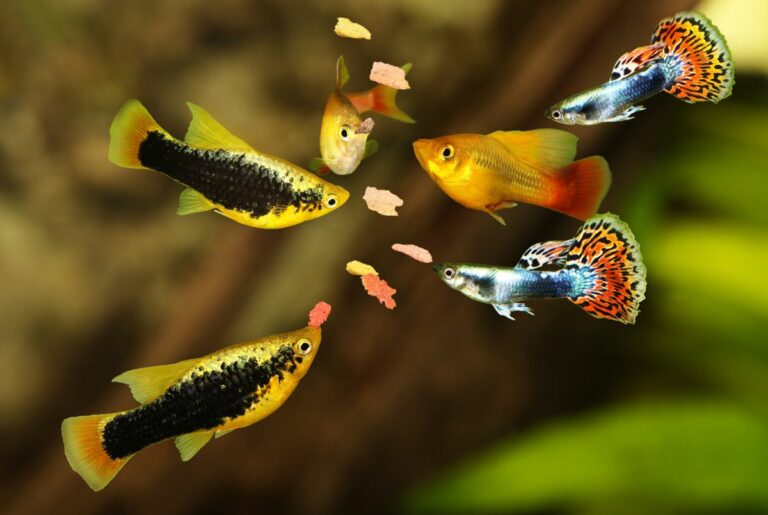
Guppies, mollies, platies and swordtails use internal fertilization and produce free-swimming young. A female can store sperm, so fry may arrive after she has been separated from males. Pregnancy does not require a male to be present in the current tank.
Developing young receive support in different ways across livebearing fishes; not every species has a mammal-like placenta. Seahorses are a separate example: females transfer eggs to the male’s brood pouch, and the male later releases the young.
Can fish change sex?
Some species do. In clownfish, the breeding female occupies the highest social rank and a breeding male can become female after her loss. The Hong Kong marine classroom profile documents male-to-female change in yellowtail clownfish. This does not mean all fish change sex or that any two adults can safely form a pair.
Preparing for breeding in an aquarium
Start with healthy, correctly identified adults and a plan for the young. Research appropriate water chemistry, spawning sites, parental behavior and first foods. Newly hatched larvae may need food much smaller than crushed flakes.
Keep water clean and stable. Do not apply abrupt pH changes, heavy water changes or higher temperatures as a general spawning trick. Use a species-specific method and match replacement water carefully.
Protect fry from unsuitable filter intakes and provide appropriate live foods when needed. Arrange space and long-term homes before deliberately producing more fish.