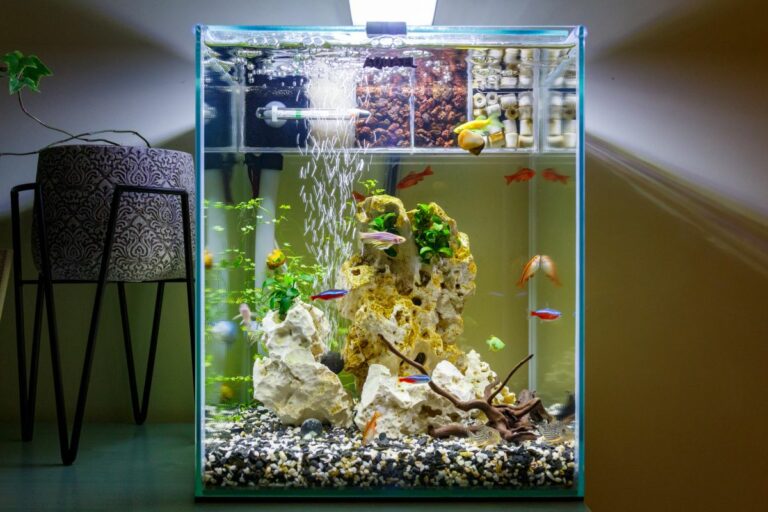
Start a marine BioCube with equipment that measures and maintains water conditions. Buy optional upgrades after you identify a specific need. Check the aquarium’s size and generation before ordering: a part described simply as “BioCube compatible” may not fit your tank.

Essentials before adding livestock
Marine salt and suitable source water
Use a complete marine aquarium salt mix, such as Instant Ocean, with suitable source water. Follow the salt manufacturer’s mixing instructions. Prepare replacement saltwater separately and verify salinity and temperature before use. Do not pour dry salt into an aquarium containing animals.
Evaporation leaves salt behind, so replace evaporated water with freshwater. A tap-water conditioner addresses specified contaminants; it does not turn every tap-water supply into suitable reef source water.
Salinity measurement and water tests
Choose a marine salinity instrument with appropriate calibration guidance and keep its measuring surfaces clean. Follow the instrument’s specified calibration method rather than assuming an inexpensive refractometer remains accurate indefinitely.
The API Saltwater Master Test Kit measures high-range pH, ammonia, nitrite and nitrate. It does not include every reef measurement: add alkalinity, calcium, magnesium or phosphate testing as your livestock and management require.
Live sand or bottled bacteria does not prove a new system is ready for fish. Establish and verify the biological filter before stocking.
Temperature control
Use an appropriately sized aquarium heater if the room cannot maintain the animals’ required temperature, plus an independent thermometer. Check the heater’s dimensions, installation depth and rear-chamber water level before purchase. A closed hood can retain heat; observe actual temperatures through the lighting cycle.
Water-change and cleaning equipment
Keep aquarium-only mixing containers, a siphon, appropriate hose and a glass-cleaning tool. Use a cleaner suited to the glass and keep sand out of its contact surfaces. A faucet-connected siphon may help remove water, but refill a marine aquarium with separately prepared saltwater.
Useful upgrades when the setup needs them
A model-specific media basket
A removable basket can make mechanical and chemical media easier to service. Verify the exact model and chamber dimensions, leaving access for removal. Choose media to address a measured need; filling every available slot is not a maintenance plan.
Remove trapped debris regularly. Do not discard all established biological filtration when changing disposable mechanical or carbon media.
Additional circulation
A small circulation pump may help eliminate poorly circulated areas, depending on the rockwork and livestock. Keep flow suitable for the animals rather than buying the most powerful pump that fits. Guard intakes where vulnerable animals could reach them.
A protein skimmer or automatic top-off
A protein skimmer can support organic export, but it is not compulsory for every lightly stocked nano aquarium. Check model-specific fit, operating depth, collection-cup clearance and hood closure.
An automatic top-off can reduce evaporation-related changes if installed and maintained correctly. It still requires freshwater refills, sensor checks and independent salinity measurements.
Use Coralife’s manual directory to identify your aquarium and replacement parts before ordering. Keep the remaining budget for maintenance supplies and replacement equipment rather than buying every accessory at startup.