The Walstad method uses a soil-based substrate and substantial plant growth to support an aquarium with fewer inputs. It is associated with Diana Walstad’s Ecology of the Planted Aquarium. It does not mean putting fish into an untested jar or abandoning water changes, oxygen management and observation.
Start with the original guidance
Walstad’s website provides her books and free articles. Her methods describe particular setups and observations, not a promise that any combination of potting soil, plants and fish will regulate itself.
In her 2023 small planted shrimp-tank article, she warns that freshly submerged soil can release ammonia and consume oxygen. This directly contradicts the idea that soil automatically prevents new-tank problems. Her small shrimp bowls also should not be treated as a stocking template for fish.
Soil, cap and planting
Review the soil’s ingredients before use. “Organic” does not automatically mean suitable underwater. Avoid unknown contamination and do not improvise heavy fertilizer enrichment or manure additions. More nutrients can create problems rather than better growth.
Use the chosen documented method’s soil depth and cap, keeping a clear distinction between garden soil and manufactured aquasoil. Do not assume every planted substrate is interchangeable as a cap. Moisten and prepare the soil, plant carefully and fill gently to limit disturbance.
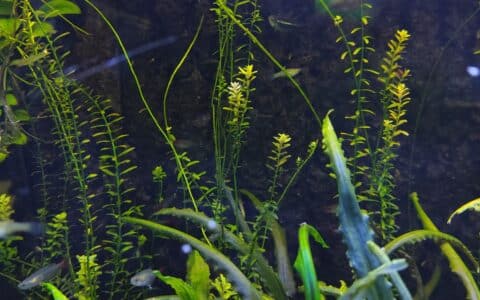
Choose several plants that suit your water and light. Vallisneria, dwarf sagittaria and suitable stems are options to assess. Include some surface-floating plants where appropriate, while keeping enough light for plants below. Hornwort can be left loose but is rootless; it should not be described as a root-feeding soil plant.
Light, circulation and temperature
Provide adequate light at the leaves and a consistent schedule. Fluorescent lamps are not inherently incapable of growing plants, and a full-spectrum label alone does not prove adequate intensity. Adjust the setup according to growth and algae rather than installing the brightest available lamp.
Do not sacrifice fish oxygenation to conserve CO2. Circulation, aeration and filtration can be used where needed. Walstad describes filter-free systems, but a densely planted appearance does not establish that your particular tank can safely run without a filter.
Keep temperature appropriate for the actual livestock. “Low tech” does not mean a heater is optional for tropical fish in a cold room. Injected CO2 is not a requirement of this approach; match plants and light to the intended level of input.
Wait for demonstrated stability before stocking
Set up and observe the planted system without fish first. Monitor ammonia, nitrite, pH and temperature, and investigate plant dieback or oxygen problems. A fixed one- or two-week wait is not proof of readiness, nor does one zero reading establish capacity for a large population.
Stock conservatively once conditions are reliably suitable, then continue testing. Choose compatible animals whose adult size, group needs and digging behavior fit the enclosure. A deeper cap does not automatically make goldfish, burrowing cichlids or crayfish suitable.
Maintenance remains part of the method
Thin plants, remove deterioration and watch for changes. Evaporation top-offs do not remove accumulated dissolved substances. Change water when conditions require it, particularly during startup or after disturbance.
Walstad’s potted-plant breeding-tank article describes a different layout that still includes plant thinning and periodic cleaning and water replacement. Its results do not justify a universal “never change water” rule.
Keep a workable maintenance and testing routine. A successful soil-based aquarium reduces some work through healthy plant growth; it still depends on attentive management.