

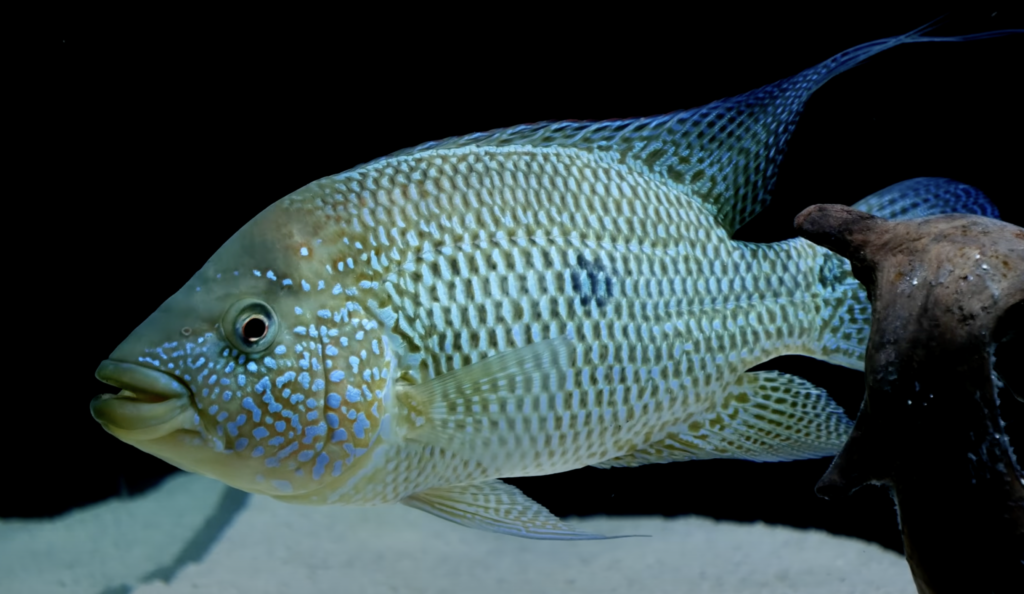
An umbee is a specialist fish for a very large aquarium, not a routine alternative to an oscar. A small juvenile can become a powerful predator capable of seriously injuring companions and a breeding partner. Have the adult accommodation available before buying one.
Identity and adult size
The umbee is Kronoheros umbrifer, also widely written K. umbriferus and formerly placed in Caquetaia. It comes from Panama and Colombia. The Cichlid Room Companion account documents its taxonomic history and identifies it as a large piscivorous cichlid.
Large males can approach two feet in total length, with females generally smaller. Locality labels and blue, green or black trade descriptions are not interchangeable breeding records. Keep reliable source information and do not promise a juvenile’s eventual color or temperament.
How much aquarium does an adult need?
Think in terms of a long, wide specialist aquarium around 1,000–1,200 litres or more, with a footprint roughly 2.5 metres long and enough width for a large adult to turn comfortably. This is a planning scale, not a guarantee that a particular pair or mixed community will work.
The Nordic Cichlid Association species register emphasizes very large accommodation and immediate separation when an umbee attacks another fish. A 150-gallon label alone is not adequate adult planning, especially for two fish or a narrow tank.
A single specimen is the most straightforward arrangement. Juvenile groups require close observation, spare tanks and timely separation as fish mature. Do not assume that raising fish together produces a safe lifelong pair.
Layout, water and filtration
Leave substantial open swimming space and use a few secure, smooth shelters. Umbees excavate substrate and can move decorations; secure heavy structures before adding sand. Protect exposed heaters, intakes and outlets, fit a secure cover and leave maintenance access.
Match temperature and chemistry to documented source stock. A stable tropical setup in the mid-20s Celsius with approximately neutral water is a practical starting point for many aquarium fish of this species; check GH and KH as well as pH. Do not raise temperature sharply to force spawning.
Finish the nitrogen cycle before stocking. Use biological filtration sized for a large fed predator, maintain oxygenation and test ammonia and nitrite, which should remain zero. Test nitrate and establish regular partial water changes. Remove food debris promptly; no particular canister-filter model replaces maintenance.
Feeding without an unbalanced meat diet
Use an accepted complete food formulated for large predatory fish as a foundation, with varied appropriate aquatic foods. Proper complete prepared foods are nutritionally formulated; they are not inherently inferior to an assortment of supermarket seafood.
Offer manageable portions and monitor body condition. Live feeder fish are unnecessary and may introduce infections. Avoid mammal or poultry meat as a staple, and do not feed heavily just to make a juvenile grow faster. Remove scraps before they decompose.
Tank mates and breeding risks
There is no dependable list of “good umbee tank mates.” Even large plecos can suffer injuries, while smaller cichlids and schooling fish may be eaten or attacked. A larger aquarium reduces crowding but does not make a determined predator compatible.
Prepare a secure divider and an established alternative aquarium before attempting a pairing. A smaller partner needs protection that does not depend on winning a fight. Openings in improvised dividers can trap fish or allow attacks, so do not treat them as a safety guarantee.
Umbees lay eggs on a cleaned surface and can defend offspring aggressively. Do not force unfamiliar adults together. If deliberately breeding identified stock, arrange substantial grow-out space and homes beforehand. Feed free-swimming youngsters appropriately sized foods and maintain their water quality; parents’ scattered leftovers are not a feeding plan.
Excellent reading material