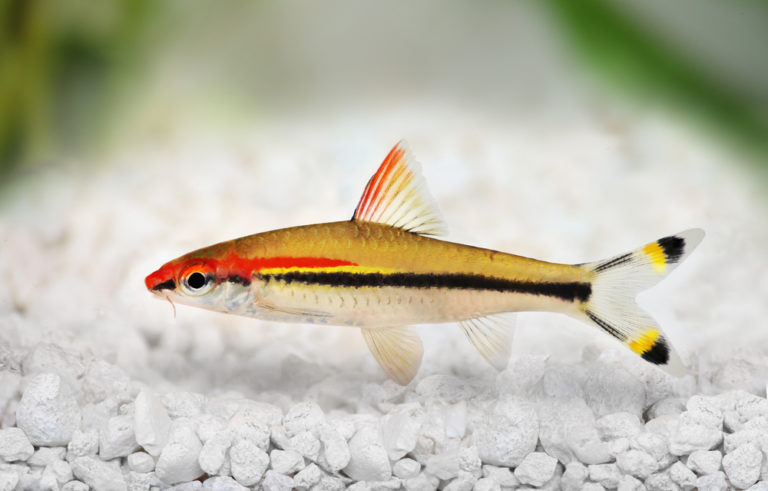
Serpae tetras are red, black-finned schooling fish with a real risk of fin nipping. They are not a dependable match for bettas, fancy guppies or other slow, long-finned fish. Choose the group and its companions before buying for color.

Group size does not eliminate fin nipping
Keep a group of at least 8–10, with open swimming room and planted retreats. A 20-gallon-long style aquarium is a starting point for a modest group; a larger community needs more room. Watch individuals for persistent chasing and injuries rather than assuming six fish automatically makes the behavior harmless.

The species is now listed as Megalamphodus eques, although Hyphessobrycon eques remains common in older books and shop labels. Seriously Fish’s updated profile reports a body length around 4 cm and recommends a footprint around 80 × 30 cm.
Water and layout
The profile gives broad ranges of 20–28°C (68–82°F), pH 5–7.5 and 1–15 dGH. Check the stock’s existing conditions and keep suitable water stable. Do not add unmeasured peat, acids or tannin products to force a particular pH.

Cycle the filter before stocking. Ammonia and nitrite should be zero; monitor nitrate and remove debris during partial changes with conditioned, temperature-matched water. Plants provide cover but do not replace filtration or testing. Water wisteria or other suitable planting can break lines of sight while leaving a swimming zone.
Companions and feeding

Consider similarly sized, active fish that share the actual water conditions and will not prey on the tetras. Avoid slow, trailing-finned residents and very small fish or shrimp. Do not add an aggressive species simply because it seems tough enough to tolerate nipping.
Persistent fin damage means the arrangement needs changing. A larger group or more planting may help distribute attention but is not a guarantee. For a different tetra with its own compatibility limits, compare black skirt care.
Use a complete small-fish food, with suitable small frozen or live foods for variety. Feed measured portions and watch subordinate fish eat. Do not compensate for harassment by leaving excess food to decay.
Breeding and daily observation
Serpae tetras scatter eggs and may eat them afterward. To raise young, prepare separate established housing, protected filtration, spawning cover and appropriately tiny initial foods. Java moss or spawning mops can provide cover. Do not promise a spawn from a rich diet alone.
Watch appetite, breathing, body condition and fins. Test water when behavior changes and seek veterinary advice for severe or persistent signs. Injured fish need appropriate care as well as removal of the cause of injury.