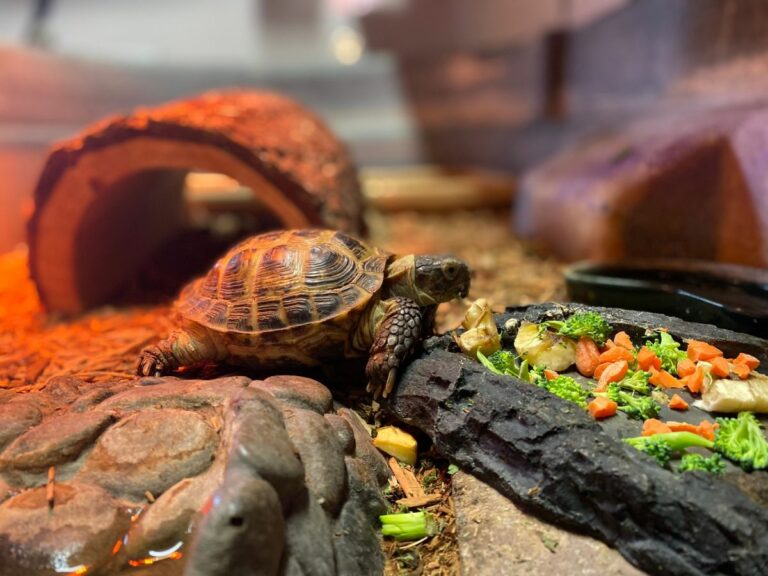
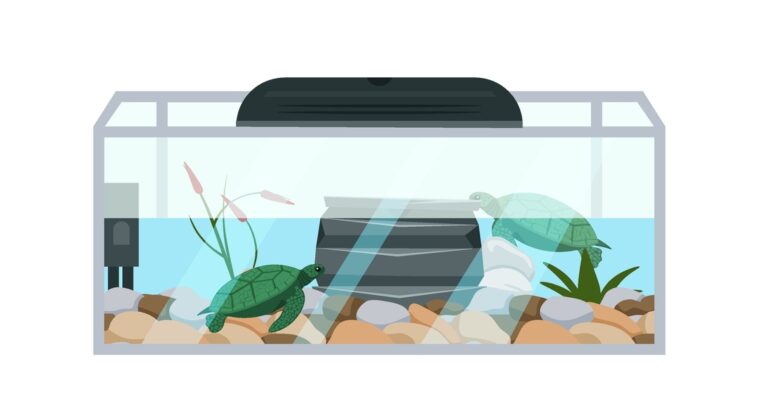
The northern map turtle, Graptemys geographica, is an aquatic basking turtle whose adult housing requirements depend strongly on sex. Males remain much smaller than females. Before buying a hatchling, plan for the larger adult you may eventually have, not just the animal’s present shell length.

Identification and the difference between sexes
Fine pale lines on an olive or brown upper shell resemble roads on a map. A low central keel, a serrated rear edge and yellow markings around the head help identification. Markings often become less obvious with age.
The Missouri Department of Conservation profile gives adult shell lengths of roughly 4–6.5 inches for males and 6.75–11.5 inches for females. These ranges are more useful than one “average” size for both sexes.
Female heads and jaws are also much larger. This is not the same species as the Mississippi map turtle, despite both being sold under the broad label “map turtle.” Confirm the scientific name.
Range and natural habitat

Northern map turtles occupy parts of the central and eastern United States and southern Canada. They are not restricted to the southern US, and records include the Mississippi River system. Regional wildlife guides are better distribution references than a short list of isolated localities.
Wisconsin DNR describes their use of rivers, side channels and backwaters, with suitable vegetation and basking opportunities. They can be strong swimmers while still needing sheltered resting areas.

Females leave the water to nest. A basking platform and a nesting site serve different purposes, so a reproductively mature female may need a suitable digging area even when no male is present. Discuss persistent digging, straining or suspected retained eggs with a reptile veterinarian.
Adult enclosure planning

Austin’s Turtle Page’s experienced-keeper guidance suggests around 75 gallons for a single adult male and at least 125 gallons for a large female. Treat these as starting plans alongside the actual turtle’s size and usable swimming footprint.
Provide a broad dry basking platform that supports the animal fully, secure ramps and submerged resting places near the surface. Hatchlings need particularly easy access to air. Increase water depth as the animal demonstrates strength and confidence, rather than using a deep empty tank from the outset.
Keep escape routes above platforms secure. Arrange heavy objects so they cannot shift, and avoid gaps that could trap a turtle underwater. Bare-bottomed tanks are straightforward to clean; loose swallowable gravel creates an avoidable risk.
Filtration, heat and lighting
Use a mature biological filter, effective debris removal and regular conditioned water changes. A filter rated for a larger fish aquarium can be useful, but the rating alone does not prove it handles a turtle’s waste. Test ammonia, nitrite and nitrate.
For routine active care, adult water around 23–25°C is a practical starting range; small juveniles may need the warmer end or a separately advised range. Provide a measured basking area around 30–35°C with cooler choices. Do not confine the entire platform to its hottest temperature.
Install appropriate UVB, check the exposure at shell level and provide a normal day–night cycle. See our UVB guide, cycling instructions and cleaning routine for the related setup details.
Diet: do not copy a slider’s vegetable ratio
Northern maps eat a predominantly animal-based wild diet. Adult females use their powerful jaws on molluscs and crustaceans, while smaller males take smaller prey. Wisconsin’s species account notes these feeding adaptations.
Use an appropriate formulated aquatic turtle food with suitable varied foods such as safely sourced invertebrates. Offer manageable pieces and remove leftovers. Some plant material may be taken, but prescribing 75% vegetables to every adult ignores this species’ feeding ecology.
Do not rely on dried shrimp or muscle meat alone, and do not collect unknown wild snails as a feeding shortcut. Review calcium and vitamin supplementation against the actual diet and UVB provision. Our turtle feeding guide covers those decisions.
Companions and health

One turtle is the simpler housing plan. Wild turtles basking together do not prove that a captive group will be compatible. Males can persistently harass females, and larger individuals can injure or outcompete smaller ones. Be prepared to separate animals permanently.

Keep handling brief and wash hands after working with turtles or their equipment. Choose documented captive-bred stock and check applicable acquisition requirements; never take an unfamiliar turtle from a local river for a home tank.
Changes in swimming, appetite, breathing, eyes or shell condition need prompt attention. Review husbandry and seek reptile veterinary assessment rather than treating every shell problem as fungus or a single nutrient deficiency. Deliberate winter cooling also requires an individual plan, not an improvised reduction in heater settings.