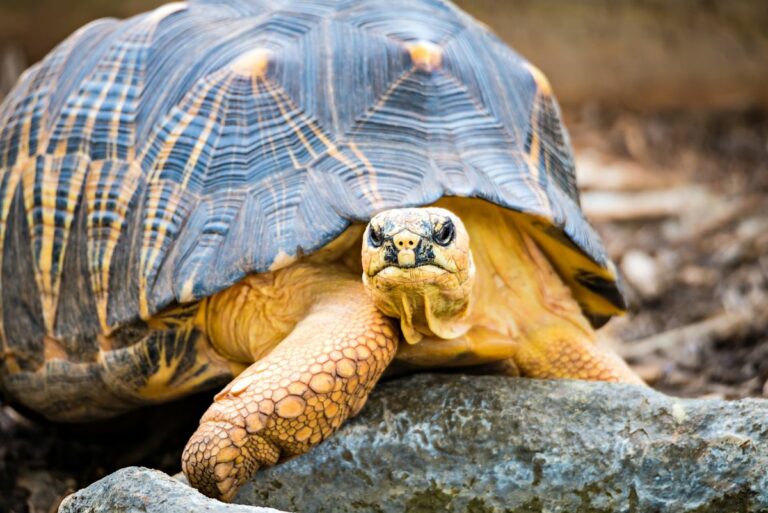
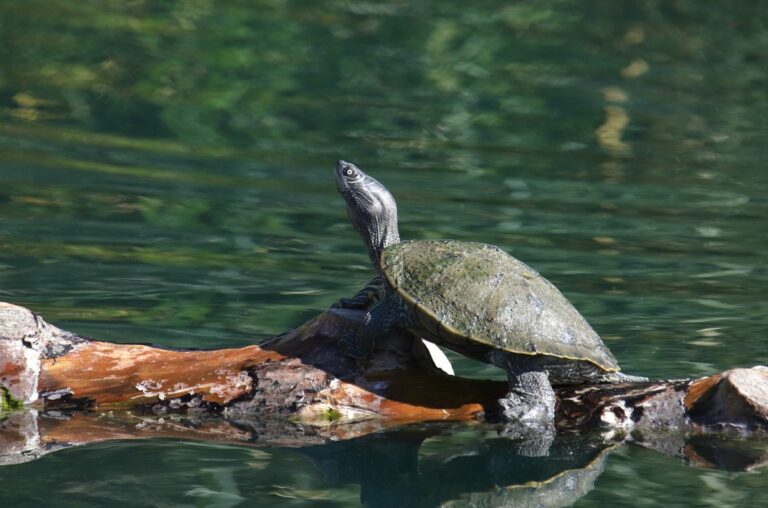
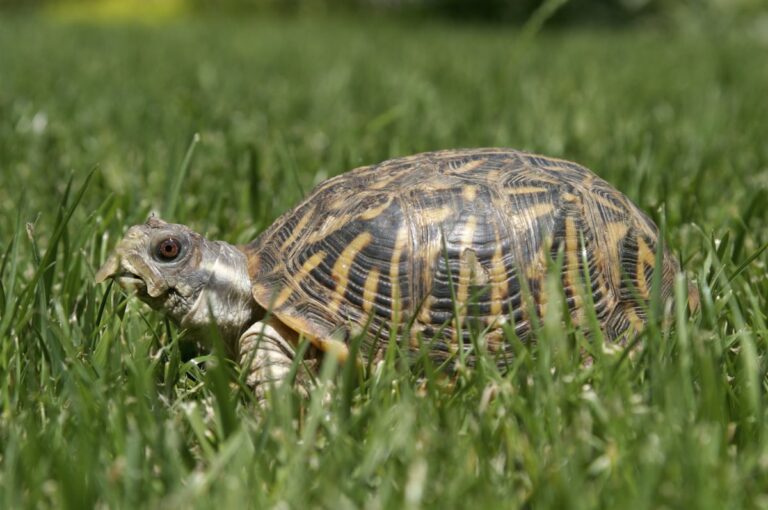
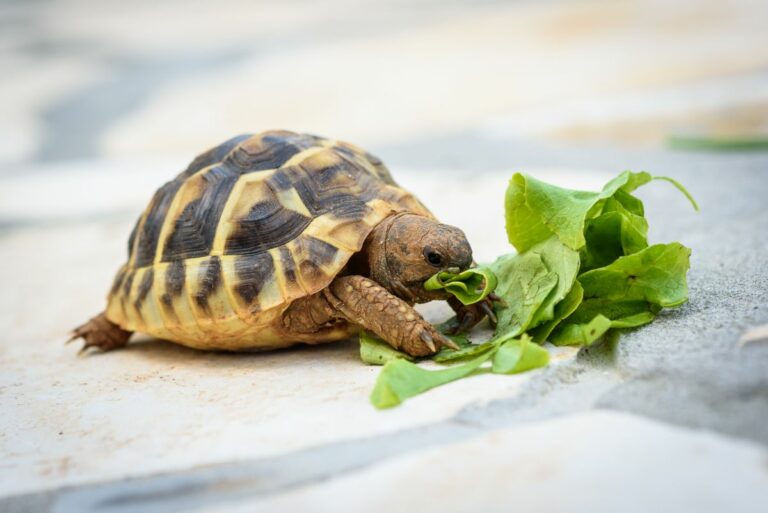
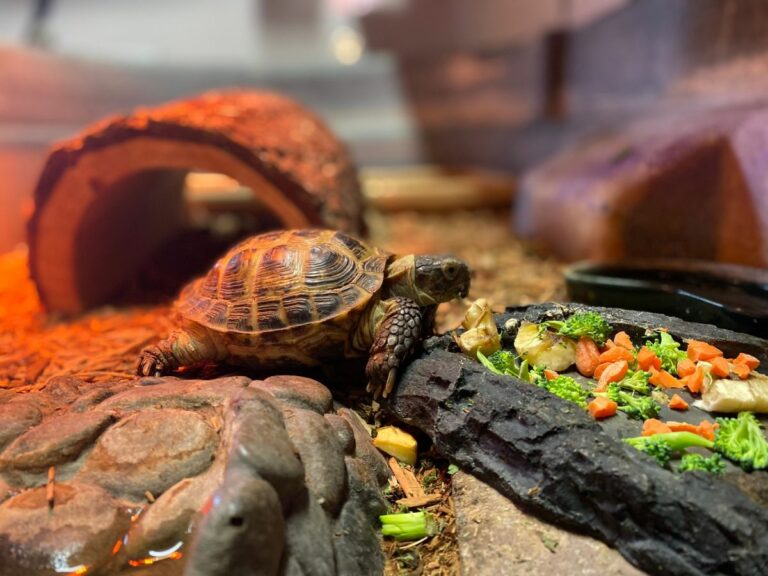
A leopard tortoise, Stigmochelys pardalis, needs extensive ground space, a fibrous grazing diet and suitable warmth throughout the year. It does not hibernate. A small hatchling is not evidence that an ordinary indoor tortoise table will remain adequate for life.

Adult size and habitat
The dark markings on a yellow or tan shell are most conspicuous in younger animals and can fade with age. Many adults reach roughly 16–18 inches (40–46 cm), while some grow considerably larger. Ask about the parents’ size where breeding records are available, and leave room in the housing plan for a large individual.

Leopard tortoises occur across parts of eastern and southern Africa, in habitats including grassland and scrub. Natural conditions vary; describing them as desert animals that need no moisture or drinking water gives the wrong husbandry message.
The Maryland Zoo species profile describes their grazing habits and appearance. Like other turtles, they use a beak rather than teeth to bite plant material.
Growing animals need a long-term plan

A hatchling needs protected, carefully monitored accommodation with warm humid retreats and safe water access. A bare, dry enclosure is not a good default simply because adults come from relatively dry regions.
Track growth and body condition rather than pushing rapid size gain. Abnormal shell growth has multiple contributing factors; one photograph or the amount of protein alone cannot establish the cause.
Space, shelter and temperature

For an adult, a secure pen around 10 × 10 feet (3 × 3 m) is a useful starting scale, with more room for a large animal. Plan suitable winter accommodation as well as summer ground space. Months in a cramped holding box are not solved by calling it temporary housing.
Provide shade, weather protection and secure boundaries. Do not assume the animal cannot climb, dig at an edge or push through a weak barrier. Protection from dogs and other predators needs more than a low perimeter wall.
In active indoor maintenance, provide a localized basking area near 95°F (35°C), with a cooler retreat around 75–80°F (24–27°C). Measure conditions at animal level and adjust for age and health. Use thermostatically controlled heating and maintain appropriate nighttime warmth, especially for juveniles.
The Tree of Life Exotic Pet Medical Center guide emphasizes substantial housing and heated shelter during cold weather. Leopard tortoises should not be put through a Mediterranean tortoise’s winter hibernation routine.
Provide appropriate daytime UVB with shaded retreats. Follow the exact lamp, reflector and screening guidance rather than using one mounting distance for every bulb. Our UVB lighting guide explains the checks.
Feed as a grazing herbivore

Offer varied suitable grasses, grass hays, edible weeds and leaves. Useful grass-hay options include Bermuda, timothy and orchard grass. Appropriate greens and cactus pads can add variety, but soft vegetables and fruit should not displace the fibrous base.
The Tortoise Trust leopard tortoise care sheet emphasizes coarse, high-fiber food. Do not feed meat, insects, dog food or cat food as routine nutrition for this species. An appropriate grassland tortoise formulation can support the plan.
Provide suitable food daily during active maintenance, adjusting portions to growth, activity and body condition. Assess calcium and vitamins against the full diet and UVB provision rather than assuming occasional dusting automatically balances an unsuitable menu.
Water and daily care
Keep fresh drinking water available in a stable shallow dish with easy entry and exit. The animal must be able to rest with its head above water. Clean and refill it daily and whenever fouled. Any separate soaking should use shallow water and supervision, especially for young animals.
Remove waste and leftovers, maintain ventilation and track appetite and weight. Warm humid retreats and good drainage can coexist; persistent cold, wet substrate and a completely dried-out enclosure are both poor solutions.
Persistent nasal discharge, abnormal breathing, weakness, shell lesions or a newly soft shell needs a reptile veterinarian. Do not treat appetite loss as an instruction to cool the animal.
Companions and lifetime care
Keeping one tortoise is simplest. Males can fight or harass females, and mixing species introduces additional care and disease concerns. Handle only when necessary, support the body securely and wash hands afterward.
Expect decades of responsibility. Check current possession and transfer rules, obtain documented lawful captive-bred or rescue animals, and never release a captive tortoise into the wild.