

The best turtle tank filter is one that works at your water level, handles the waste load, protects the animal from the intake and is easy enough to maintain regularly. A high advertised flow rate or a “turtle” label alone does not establish that a filter fits the enclosure.

The illustration above shows products from an earlier comparison. Use the current model’s manual and specifications when shopping; the pictured lineup is not a current performance ranking.
Choose the filter type for the layout
| Type | Advantages | Limitations to check |
|---|---|---|
| External canister | Substantial media capacity without occupying swimming space | Required installation height, priming, hose security and leak checks |
| Internal filter | No external hose loop; can suit smaller systems | Minimum immersion, media capacity, occupied space and protected intake |
| Hang-on-back filter | Accessible media and simple servicing | Low water levels, noisy waterfalls and reliable restart after an outage |
| Pond filtration | Can suit large tubs or outdoor systems | Pump and intake safety, weather rating, seasonal conditions and cleaning access |
For a large adult turtle, a suitably sized canister is often a practical choice. For a shallow enclosure, confirm that the intake, outlet and pump arrangement actually work before buying. More current is not automatically better for a hatchling or weak swimmer.
Examples worth checking against your setup
Fluval FX series
The Fluval FX manufacturer FAQ covers installation and operating requirements for the series. Check canister clearance, hose routing, priming and the position relative to the waterline. A large canister is not automatically suitable beside a floor-level pond with the wrong height relationship.
Zoo Med Turtle Clean 30
Zoo Med’s Turtle Clean 30 page describes this turtle-oriented canister, formerly called the 511. Match the exact model and instructions to your working water volume. The word “turtle” does not make a small filter adequate for every adult species.
Penn-Plax Cascade canisters
Penn-Plax’s instruction library provides model-specific Cascade manuals. Compare media capacity, physical fit, priming and parts availability. Do not transfer one Cascade model’s flow or tank rating to another.
These examples illustrate options, not independently measured reliability results. Manufacturer aquarium ratings are starting information, not a guaranteed turtle stocking capacity.
Size for waste and working volume
Use the water volume actually present, not the tank’s full nominal capacity. Our aquarium calculator estimates gross volume at your chosen waterline, before displacement.
Then account for turtle size, number, food load, media volume and cleaning interval. Advertised pump flow can differ from flow through loaded media and installed hoses. A “double the tank rating” rule can be a rough shopping shortcut, but it cannot replace these checks.
Guard the intake and leave no trapping gap behind the equipment. Direct the return so the animal has quieter resting areas. Check that it can surface and reach the basking ramp comfortably.
What the media actually do
Mechanical media catch particles and need cleaning before clogging reduces flow. Biological media provide surfaces for microbes that process ammonia and nitrite. Ordinary biological filtration does not reliably eliminate nitrate or make the enclosure sterile.
Chemical media such as activated carbon have specific uses and finite capacity. They do not replace a cycled biological filter, testing or water changes. Carbon can also interfere with some treatments, so follow medication and media instructions.
Maintenance that preserves the cycle
Remove leftovers and visible waste promptly. Check flow and rinse reusable mechanical media as needed. Service hoses, impellers and seals according to the manual, switching equipment off safely first.
Do not replace all biological media at once or let it dry during ordinary cleaning. Follow the manufacturer’s care instructions and retain established media wherever possible.
Continue partial water changes with conditioned water and test ammonia, nitrite and nitrate. Our turtle cleaning guide explains the routine. Persistent ammonia or nitrite means the system needs attention even if the water looks clear.
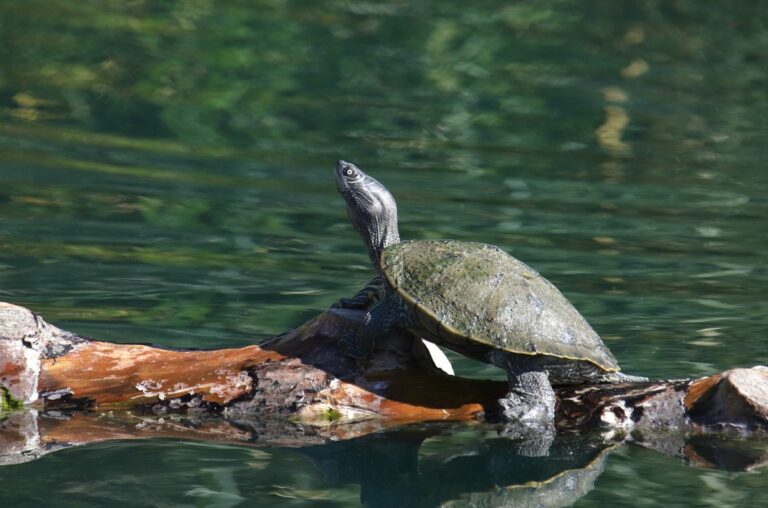
I have a Yellow Bellied Slider that I got when I was a kid, 70 years ago. Myrtle now lives in a 500 gallon in-ground pond that I built 20 years ago. I have many Myrtle experiences that I could share. We have been told that she is probably the oldest Slider in captivity. She has grown from a half dollar size to nine pounds and is very high maintenance and I need some suggestions for a better filtering system.