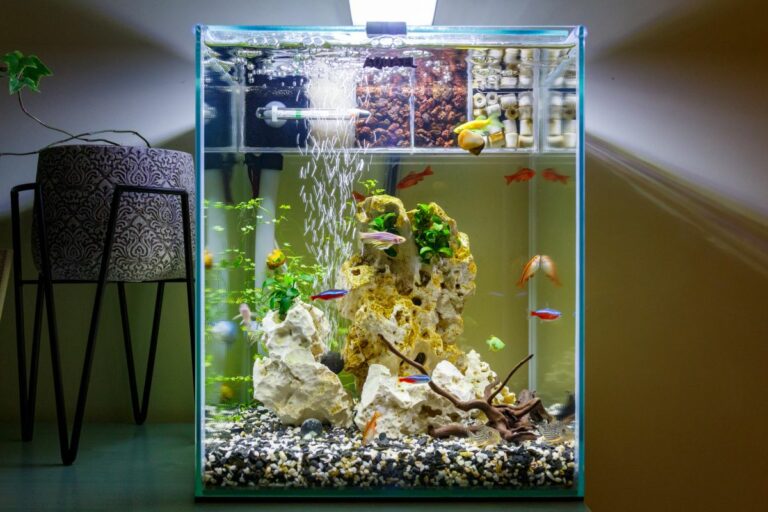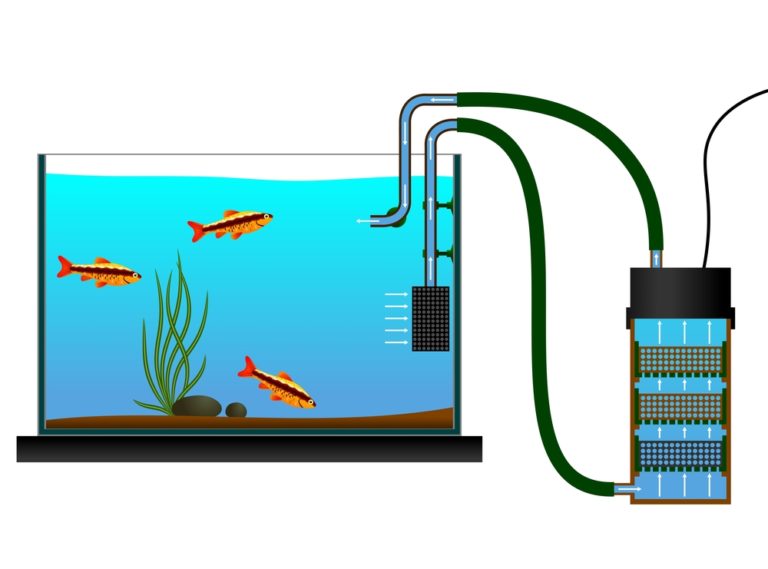
A hang-on-back filter keeps its media chamber outside the aquarium and returns water over the rim. It can be easy to access and service, but needs suitable clearance, dependable restart behavior and flow appropriate for the animals.

Five filter families to compare
AquaClear and Fluval AC
The AquaClear design uses a removable media basket. The newer Fluval AC range has models from AC20 to AC110, with manufacturer tank ratings from 5–20 to 60–110 US gallons. Check the exact generation for media, impeller and motor compatibility rather than ordering solely by a familiar name.
Basket access is useful when you want to service mechanical media while retaining established biological media. Match size and outlet flow to the tank rather than treating a larger filter as permission to overstock.
Marineland Penguin
Penguin BIO-Wheel filters combine cartridges with a rotating biological-filtration wheel. Inspect wheel movement and water delivery during maintenance. The manufacturer’s Penguin manual provides checks for obstructed wheels, bearings, intakes and cartridges.
A biological stage supports nitrifying bacteria after establishment; it does not make a new aquarium instantly cycled or eliminate the need to manage nitrate.
Penn-Plax Cascade
Penn-Plax offers several Cascade hang-on sizes. Its instruction-sheet directory separates the hang-on models from Cascade canisters. Confirm model number, output adjustment, supplied media and replacement availability before ordering.
Check that the body fits behind your tank and that the intake will clear substrate and decorations. An adjustable flow control is useful only within the filter’s intended operating range.
Fluval C Series
The C Series separates mechanical, chemical and biological filtration into serviceable stages. Compare access to those components and the cost of replacements with the simpler basket arrangement of other models.
Flow controls can help tailor the return, but do not assume a reduced setting preserves identical performance under every stocking level and maintenance condition.
Aqueon QuietFlow
QuietFlow covers different generations. Aqueon’s current PRO listing describes an internal self-priming pump, a cartridge holster and separate biological surfaces. Check the exact filter before assuming it has an LED indicator or uses the same cartridge as an older LED PRO.
A cartridge indicator is a prompt to inspect the filter, not proof that the intake, pump and biological surfaces need no other maintenance.

Fit, flow and servicing matter most
Measure rim thickness, lid openings and rear clearance. Protect fry or shrimp from the intake with a suitable prefilter where needed, and keep that prefilter clean. Gentle-flow fish need an appropriate return pattern; deliberately undersizing biological filtration is not the solution.
Prime the filter as instructed and check restart behavior during a supervised power interruption. Keep the intended water level: a longer waterfall can increase noise and alter circulation. Never run a pump dry unless its instructions specifically permit it.
Remove trapped debris before it restricts flow. Preserve established biological media while servicing other stages, and follow the manual for pump and impeller cleaning. Replacing every wet component at once can disrupt the biological filter.
Choose a model you can maintain consistently. A HOB can suit many tank sizes, while a sump offers different equipment space and plumbing demands. Neither design removes the need for sensible stocking and water changes and maintenance.