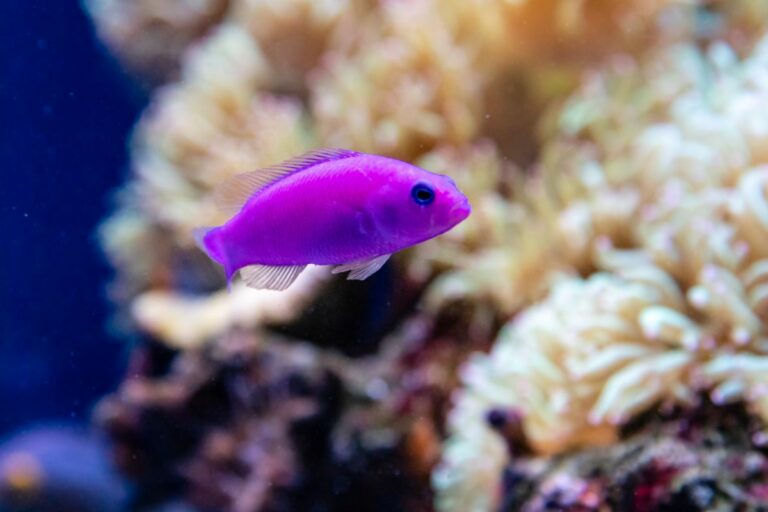
A flame angelfish (Centropyge loricula) needs more planning than its small size suggests. This active marine grazer establishes a territory, can harass other dwarf angels and may nip corals or clam mantles. Choose it for a mature aquarium where you can manage those risks.

Size and aquarium requirements
Expect a fish around 4 inches (10 cm), though published maximum sizes vary. The Australian Museum’s profile describes its western-to-central Pacific distribution and reddish-orange body with dark bars. Collection-locality color descriptions are broad tendencies, not a guarantee of a particular shade.
LiveAquaria recommends at least 70 gallons. Plan the permanent aquarium before buying a juvenile. Rockwork should provide multiple retreats and grazing surfaces while leaving swimming routes open. Tank volume alone does not resolve an exposed layout or incompatible stocking.
| Planning point | Practical starting point |
|---|---|
| Stocking | One flame angel for a typical community aquarium |
| System | Mature, biologically stable marine tank with established rock surfaces |
| Temperature | A stable 75–78°F (24–26°C) suits the overlap in commonly published care ranges |
| pH | 8.1–8.4, with stable alkalinity |
| Reef salinity | Approximately 1.025 specific gravity, measured with a calibrated instrument |
| Ammonia and nitrite | Undetectable on appropriate aquarium tests |
Do not use this fish to cycle a new aquarium. A completed nitrogen cycle establishes basic filtration; it does not instantly create mature grazing habitat. Provide oxygenation, sheltered areas away from the strongest flow and a regular light-dark cycle.
Feeding a flame angelfish
Offer marine algae and algae-based foods alongside a suitable prepared marine diet and small meaty items such as mysis. Use small feeding opportunities spread through the day rather than one oversized serving. Observe what the individual actually swallows; grazing movements alone do not demonstrate adequate nutrition.
The TFH species profile emphasizes mature live rock, an algae-based diet and hiding places. Existing growth supplements feeding rather than replacing it. A refugium is optional, not a guarantee that enough suitable food reaches the fish.
Check body condition and appetite regularly. If the fish stays hidden, loses condition or repeatedly misses food, investigate bullying and health as well as food choice. Increasing food indefinitely can worsen water quality without solving access to meals.
Corals, clams and tankmates
“Reef safe with caution” means accepting a real possibility of damage. Flame angels may pick at both stony and soft corals, other attached invertebrates and giant clam mantles. Neither an SPS-only collection nor frequent feeding makes an individual reliably safe.
Have a workable removal or relocation plan before introduction. Watch for repeated picking at the same animal, closed polyps or damaged tissue. A fish-only aquarium with live rock avoids the coral compatibility gamble.
Assess potential companions by species, adult size and behavior. “Wrasses,” “damsels” and “tangs” include fish with very different space and aggression requirements. Avoid predators, persistent bullies and fish too timid to retain access to shelter or food. Adding the angel after more peaceful residents can help, but observation remains necessary.
Keep one dwarf angel unless you have the space, experience and separation options for a deliberate pairing or mixed-angel project. Different colors do not guarantee compatibility. Two purchases do not automatically become a pair, and a fixed gallon threshold cannot guarantee that multiple angels coexist.
Buying and quarantine
Ask the supplier to demonstrate feeding and explain origin and recent holding conditions. Inspect swimming, breathing, fins and body condition. Captive-reared flame angels have been produced, but verify the origin of the actual fish rather than assuming availability, price or feeding behavior from a listing.
Use a suitable quarantine system before introduction. Rapid breathing, flashing, white spots or a dusty appearance require prompt assessment. Marine ich and velvet are different infections; lowering pH is not a treatment plan. Choose any medication with species tolerance, product formulation and measured concentration in mind, under experienced aquatic veterinary guidance.
Breeding is a separate project
Flame angels are protogynous hermaphrodites, capable of changing from female to male. That biology does not make casual juvenile grouping safe or prove that every displaced male reverses sex.
Spawning releases eggs into the water column. Raising the larvae requires much more than protecting a filter intake or adding green water. In his firsthand pygmy angelfish culture research, Frank Baensch describes specialized larval conditions and suitable copepod prey as crucial advances. Arrange dedicated egg collection, live-food production and rearing facilities before attempting production.