Your RO/DI water’s TDS has risen, and replacing every cartridge feels like the quickest answer. Measurements at the individual stages can show which part actually needs attention.
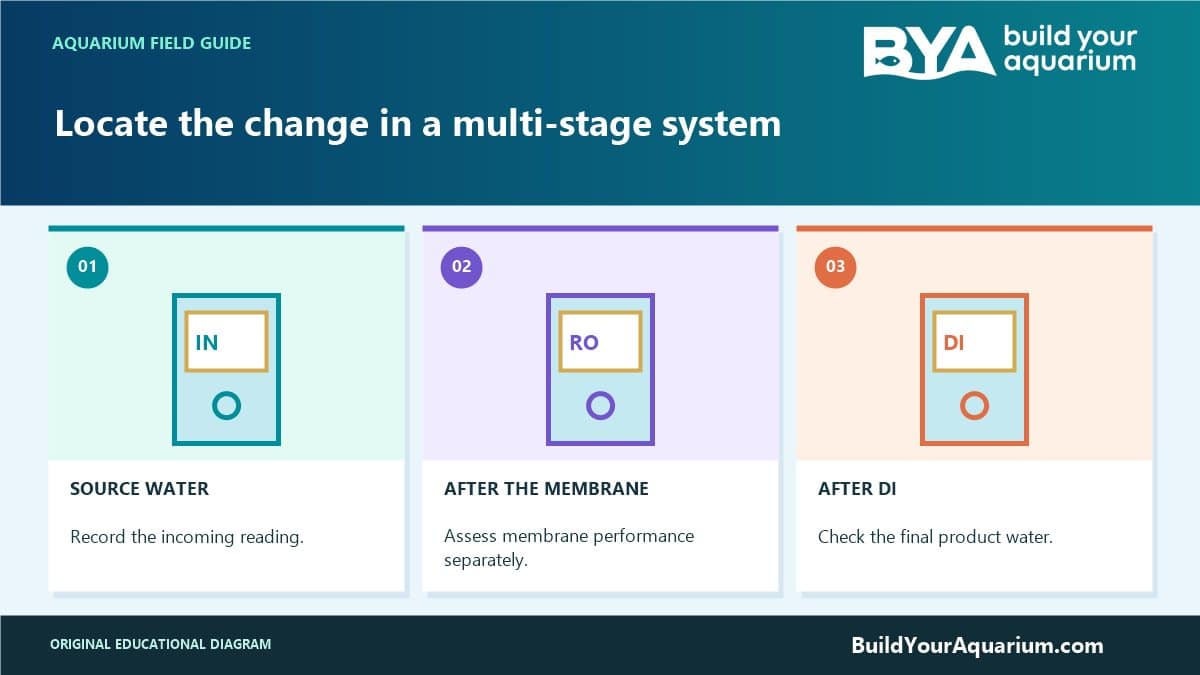
The RO membrane and DI resin perform different jobs. One final reading cannot tell you how much work each is doing.
Identify where the meter is sampling
Check the tubing and probe locations against the system diagram. Record source-water TDS, water after the RO membrane and final water after DI. Use clean sampling equipment and the manufacturer’s startup procedure.
Bulk Reef Supply’s maintenance guide treats membrane performance and DI exhaustion separately. Check its guidance against the specifications of your exact system rather than applying one universal replacement interval.
Compare the membrane with its own specification
Rejection compares incoming and membrane-output TDS. As a simple example, 200 ppm entering and 4 ppm leaving the membrane corresponds to 98% rejection: (200 − 4) ÷ 200 × 100.
That example is arithmetic, not a promised operating target for every membrane. Pressure, temperature, startup conditions and the meter can affect interpretation. Follow the rated test conditions and service instructions.
Do not make TDS answer every question
Sediment and carbon stages have maintenance requirements that a final TDS number does not fully describe. A low reading is not an independent chlorine, chloramine or microbiological test.
Keep the production log alongside your water-testing routine. Follow the instructions for mixing the actual salt formula and verify the finished batch’s salinity rather than assuming an acceptable source-water reading proves the replacement water is correct.
After service, complete the specified flushing and check all connections. Save the new baseline so the next change can be assessed against actual performance.