An indoor turtle enclosure needs suitable UVB exposure as well as heat and visible light. Choose the lighting for the species and the actual enclosure, then check the exposure at the animal’s position. A bulb’s percentage or wattage alone does not tell you whether the setup is correct.

What UVB does for a turtle
UVB helps the skin produce vitamin D3, which supports calcium absorption and normal bone and shell health. It does not supply calcium by itself, and good lighting cannot compensate for an unsuitable diet.
Veterinarian Frances Baines’ UVB guidance explains the link between UVB, vitamin D and calcium metabolism. Required exposure differs among reptiles according to their normal habitats and basking behaviour. An open-sun basking slider and a more sheltered species should not automatically receive identical lighting.
UVB, UVA and heat are different

UVB supports vitamin D synthesis. UVA contributes to reptile vision and behaviour. Heat allows the turtle to regulate body temperature. These functions can overlap in a lighting system, but they are not interchangeable.
An ordinary LED aquarium light is not a UVB source. A normal basking bulb can provide heat without useful UVB. Conversely, a fluorescent UVB tube usually does not provide sufficient basking heat on its own.
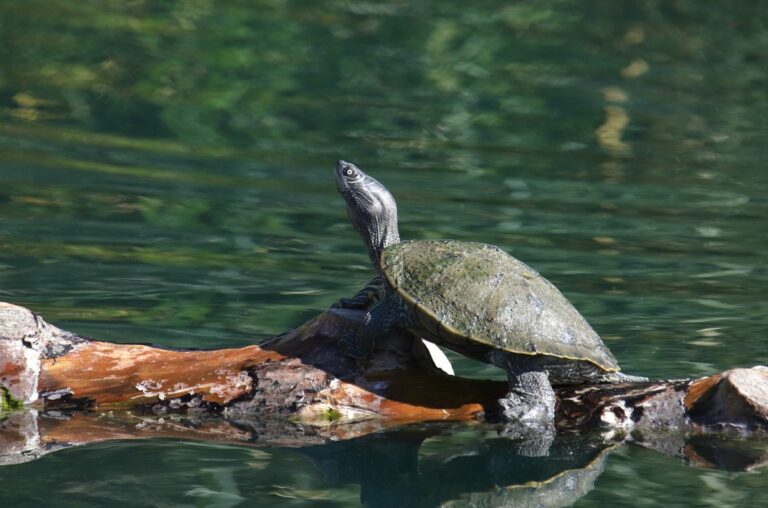
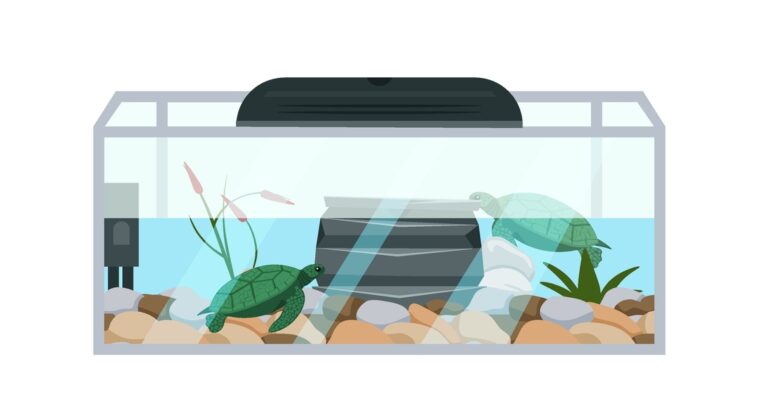
Arrange heat and UVB so an animal basking in the intended area receives both, while retaining cooler, shaded choices. The basking platform must let an aquatic basking species leave the water fully.
Choose the lamp and fixture together
Use an established reptile UVB product with a compatible fixture and published installation guidance. Linear fluorescent systems can cover a useful basking area; compact and combination lamps have different output patterns and placement requirements.
“Full spectrum” on a package does not prove the lamp emits adequate UVB. Equally, a 5%, 6% or 12% label is not a complete measure of exposure at shell level. Tube design, reflector, distance and barriers all matter.
Reflectors are not inherently unsafe. Many UVB systems are designed and tested with their supplied reflector. Follow the instructions for that complete system rather than removing it or substituting a different dome.
Set the distance using actual exposure

Use the manufacturer’s species and distance guidance, such as Arcadia’s lighting guide, for the exact product and installation. Measure to the turtle’s exposed body position, not just to the floor of an empty platform. Reassess as the animal grows or the basking area changes.
Ordinary glass and plastic can block useful UVB. Mesh can reduce output too; account for it rather than assuming every lid transmits the same amount. A suitable UV Index meter is useful for checking the actual basking exposure and ensuring shaded areas remain available.
There is no dependable universal rule that every low-percentage lamp belongs 12 inches away or every 5% lamp belongs 18 inches away.
Use a daytime schedule and replace aging lamps
Provide a consistent day–night cycle suitable for the species, commonly around 10–12 hours of daytime lighting in indoor setups. Turn visible and UVB lamps off at night. If additional overnight heat is required, use an appropriate controlled heat source rather than assuming coloured night bulbs are invisible to the turtle.
UV output can decline while a lamp still looks bright. Follow the specific manufacturer’s replacement interval and monitor output where possible. A blanket six-month replacement rule does not fit every lamp technology.
Check health as well as equipment

Soft or abnormal shell development, weakness, tremors or difficulty moving warrant assessment by a reptile veterinarian. Do not respond by adding high-dose vitamin D or calcium without guidance; the cause and treatment need evaluation.
Review the whole enclosure alongside the lighting. Our guides to cycling a turtle tank and maintaining turtle water quality cover other essential parts of a functioning habitat.