Freshwater angelfish are South American cichlids in the genus Pterophyllum. This guide focuses on the familiar captive-bred P. scalare forms, including koi, marble and black angelfish. They are unrelated to marine angelfishes and should not be housed using marine care advice.
Plan for height and adult territory
An adult common angelfish can reach about 15 cm in body length and 20 cm or more in total height. Long-fin strains need extra clearance. Aqueon recommends 55 gallons or larger for full-grown fish; a group or substantial community may need considerably more.
Tank height matters, but it does not replace length and width. Arrange tall plants and stable wood to provide retreats without obstructing swimming. A group of juveniles may coexist until pairs form, then become much harder to house. Have a separation plan before that happens.
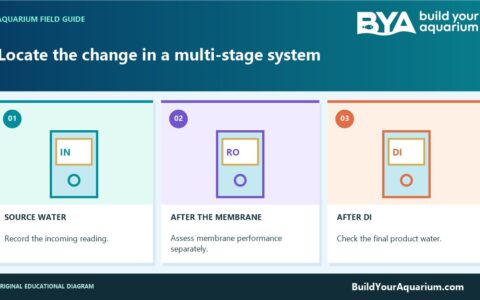
The infographic below lists 30 gallons as a minimum. For permanent adult housing, use the larger recommendation above and assess the actual footprint, clear water depth and stocking rather than treating that graphic’s volume as sufficient for a group.

Establish the aquarium before adding fish
Use conditioned water with temperature and chemistry suitable for your stock. Store-bought water is not automatically correct: test it, just as you would test tap water. Treat chlorine or chloramine according to the conditioner instructions before refill water contacts the fish or filter.
Complete a fishless cycle and verify filter performance with tests. Do not use guppies or mollies as a live test of whether the tank is ready. Cycling has no guaranteed one-week completion date.
The species reference lists 24–30°C, pH 6.0–7.4 and 0–15 dGH. Captive strains can have different tolerances from wild fish. Ask the breeder or supplier about their water and choose stable appropriate conditions instead of pursuing an exact acidic number.
Food and maintenance
Feed a suitably sized complete flake or pellet, with appropriate frozen or live foods for variety. Observe swallowing and make sure quieter fish can eat. Avoid oversized meals, uneaten food buildup and using feeder fish as a routine diet.
Keep ammonia and nitrite undetectable. Use nitrate trends, stocking and waste accumulation to set your water-change routine, rather than assuming every aquarium can wait a month. Siphon accumulated debris and service filter media when flow or cleanliness requires it. Preserve biological media and do not replace everything at once.
Plants such as Amazon swords can provide useful structure, but they do not replace filtration or water changes. Choose lighting for the plants and tank; aquarium plants do not require a blanket recommendation for UVA/UVB exposure.
Companions must fit adult behavior
Small fish and shrimp may become prey as angels grow. Fin nippers can damage their long fins, while aggressive cichlids can corner them. A pairing that worked with juveniles may fail after maturity or spawning.
Choose peaceful, suitably sized companions with overlapping requirements and enough space for their own social groups. Use the angelfish tank-mate guide as a screening tool, then observe the actual fish. Quarantine additions before introduction.
Breeding is a separate housing commitment
A compatible pair often cleans a vertical surface, lays eggs and guards them. Sexing from forehead shape or color is unreliable; spawning behavior and genital papillae are more useful near breeding.
Protect other inhabitants from the pair’s territory. Parents may care for eggs and fry, but they can also eat them. Decide in advance whether you have a dedicated breeding setup, suitable rearing space and enough first food. Newly free-swimming fry commonly take freshly hatched brine shrimp once their yolk reserves are used.
Repeated spawning is not a reason to keep producing young without housing and rehoming capacity. Maintain water quality, protect fry from filter intakes and watch for renewed aggression between the parents.