The viewing glass is clean, but a thin film sits between the floating plants. Wiping the front panel will not address material collecting at the air-water interface.
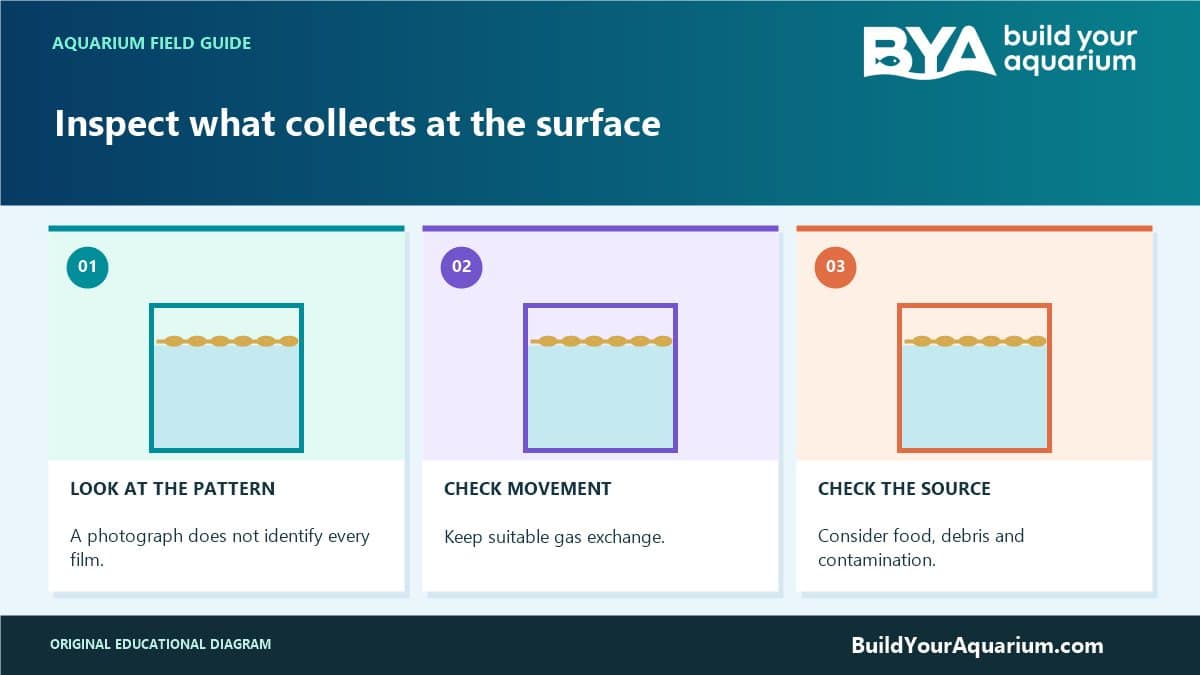
Look at the surface, the filter return and recent additions before deciding what equipment or treatment to use. Appearance alone cannot prove that every oily-looking film has the same origin.
Check the still areas
Watch whether the return moves the whole surface or leaves sheltered pockets. Dense floaters and hardscape can change that pattern. Maintain suitable movement and open access for animals that use the surface rather than eliminating circulation to keep every plant perfectly still.
Our aeration guide explains how movement supports gas exchange. A film’s appearance is not a dissolved-oxygen measurement, so check the animals’ breathing too.
Remove accumulation and investigate recurrence
Clear accessible floating debris and review excess food, decaying plant material and anything recently added. If a household spray, oil or other contaminant may have entered, treat that as a separate contamination problem; do not assume an ordinary biological film explains it.
A suitable surface skimmer can collect surface material. EHEIM’s surface-skimmer information describes that function. Check intake protection, water-level limits and maintenance before adding one to a tank with shrimplets or fry. Inspect protective fittings for clogging and gaps after servicing; protection and useful circulation both need to remain intact.
Keep plant management in the routine
Thin floaters appropriately and preserve access to equipment. Use the floating-plant guide to plan coverage without sealing the whole top.
Note where the film returns and what changed before it appeared. That record is more useful than repeatedly removing the visible layer while leaving its source and the surface-flow pattern unexamined.