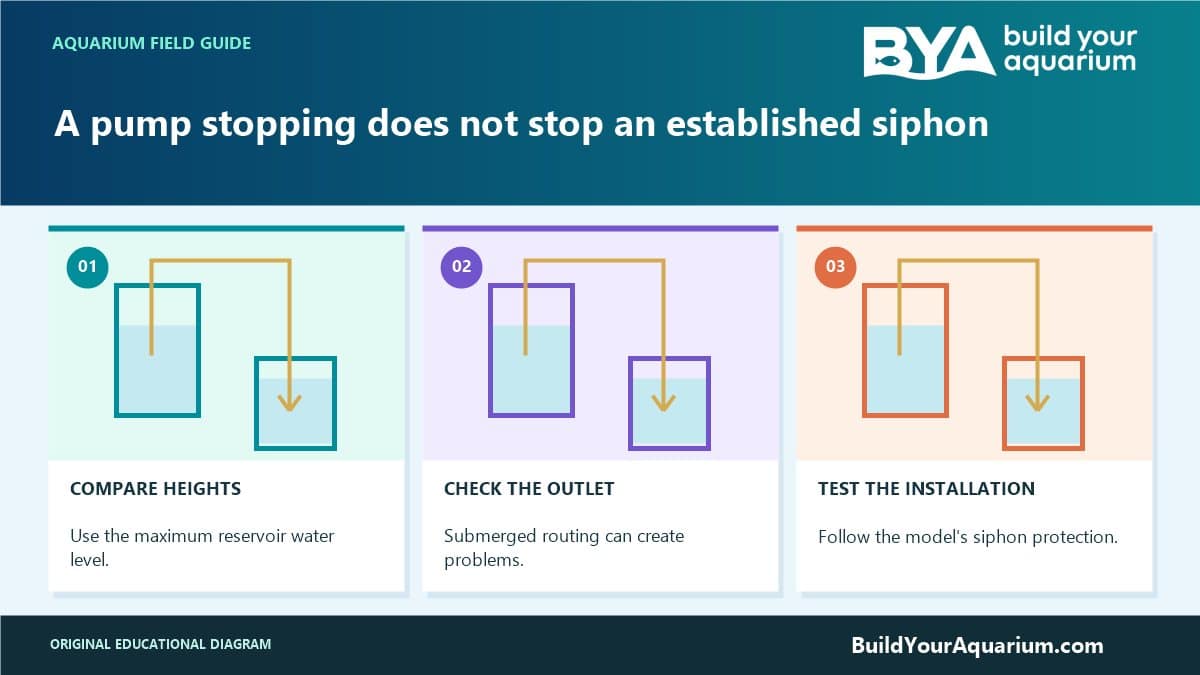
The top-off controller turns its pump off, but water keeps moving through the tube. A working sensor cannot stop a siphon created by the way the reservoir and outlet are arranged.
Check the tubing route and relative water levels before replacing the controller.
Separate pump operation from gravity flow
Bulk Reef Supply’s ATO FAQ explains how freshwater can continue entering after a pump stops. Outlet height relative to the reservoir and correct installation of any siphon-break fitting matter.
Follow the arrangement required by your own system. Check conditions with the reservoir full, not just when it is nearly empty. Also consider whether a submerged outlet can allow aquarium water to move backward.
Keep the outlet secured
A loose tube can slip lower after maintenance, changing an installation that previously worked. Use the specified holder and keep fittings accessible for inspection.
Do not add an improvised restriction and assume the problem is solved. A check valve or siphon-break component has to be suitable, correctly positioned and maintained. Our ATO equipment guide covers safeguards worth comparing.
Limit the consequences of a failure
Use a deliberately sized reservoir and supervise a complete operating test according to the manual. A supply connected continuously to a large water source changes the potential damage.
If unintended freshwater has already entered, stop the flow, assess water level and verify salinity before making a controlled correction. The sump guide explains why operating level and spare capacity need their own checks.
Inspect the routing again whenever you move the reservoir, tube or sensor. The controller’s normal screen is only part of the evidence that the system is behaving correctly.