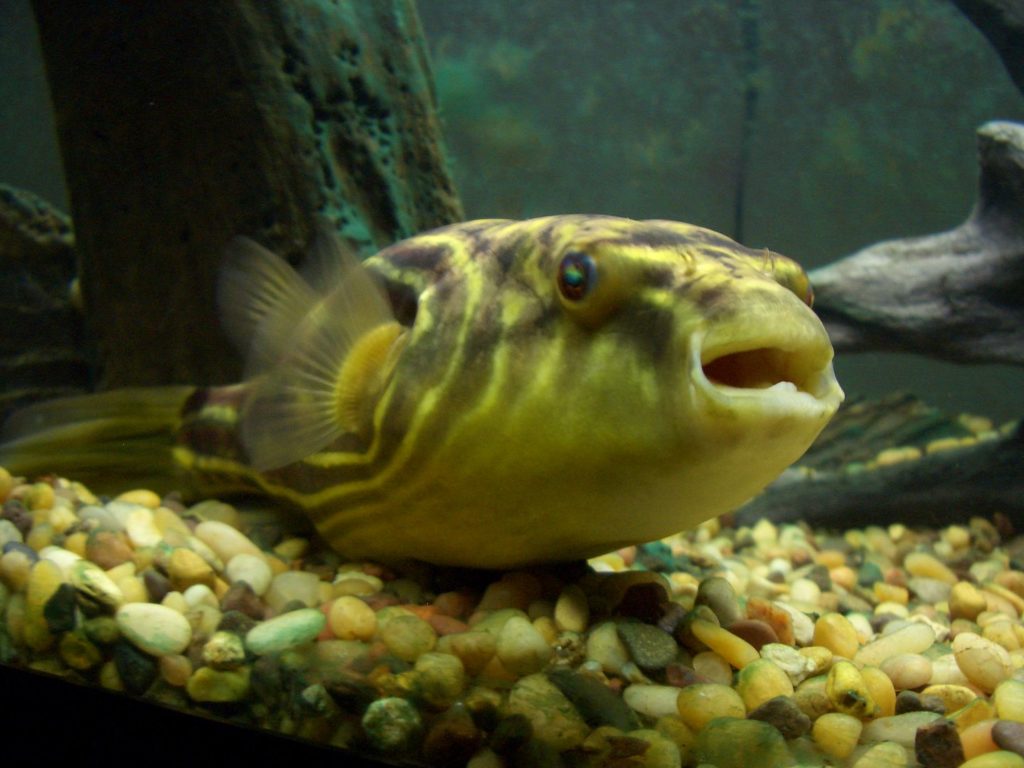
A fahaka puffer, Tetraodon lineatus, is a large freshwater fish for a dedicated aquarium. Adults can reach around 43–45 cm (17–18 inches), need substantial swimming and turning space, and can seriously injure companions. Buy one only when its adult housing and food supply are already practical.
Adult tank size: prioritize length and width
Plan around a 6-foot aquarium with at least a 2-foot front-to-back width, preferably wider for a large adult. A tall tank does not compensate for a narrow footprint. Standard 75-, 90- and narrow 125-gallon tanks are not suitable permanent adult housing.
Pufferfish Enthusiasts Worldwide treats 5 × 2 × 2 feet as an absolute minimum and encourages larger housing. The more generous footprint above leaves additional room for movement and furnishings. Check actual internal dimensions, not just the advertised gallon capacity.
Have the adult setup running before purchase. A juvenile’s small shop size does not establish how long it can remain in temporary housing. Arrange structural support, accessible plumbing and a realistic water-change routine for the full aquarium.
Freshwater conditions and filtration
Fahakas do not need salt routinely added. A stable temperature around 24–26°C (75–79°F), pH 6.5–7.5 and moderately mineralized water fit the species profile. Confirm the supplier’s conditions and avoid abrupt changes in temperature, hardness or pH.
Complete a fishless cycle first. Ammonia and nitrite should read zero. Use adequate biological and mechanical filtration, surface movement and protected intakes, while retaining resting areas away from the strongest outlet.
Remove food scraps after meals, siphon accessible debris and test nitrate to guide regular partial water changes. A large filter does not remove dissolved waste indefinitely. Keep replacement water conditioned and appropriately matched to the aquarium.
Layout, substrate and equipment protection
Provide smooth sand where the fish can settle, secure wood or smooth rockwork and open routes through the aquarium. Avoid sharp gravel, unstable stacks and tight gaps that an adult can enter but cannot turn around in.
Anubias and Java fern can supply cover, but even tough plants may be bitten. Attach them securely without blocking swimming space. Protect heater surfaces and equipment cables from contact and chewing, and fit a secure cover.
Food and tooth condition
Offer varied, appropriately sized aquatic invertebrate foods, including suitable shell-on items. Use food from dependable sources, free of seasoning and added sauces. Thaw frozen portions before feeding. Do not offer frozen-solid pieces as a substitute for suitable shell texture.
Match food size to the fish. A juvenile cannot handle the same shellfish as a large adult. Confirm that new fish actually accept the foods available to you; being hungry does not guarantee immediate acceptance of a different diet.
Monitor body condition and feeding action rather than feeding whenever the fish approaches the glass. Persistent difficulty biting, dropped food or visible overgrowth needs experienced aquatic veterinary assessment. Do not attempt tooth clipping or sedation without that expertise. Keep fingers away from the mouth and avoid hand-feeding.
Tank mates: keep a dedicated specimen
The safest plan is one fahaka without fish companions. Small fish can be eaten, large fish can lose tissue to bites, and armor does not protect every body part. Feeding the puffer generously does not remove this risk.
A video of an mbu puffer living with guppies does not establish fahaka compatibility. Nor should a peaceful period be treated as a permanent guarantee. Other fahakas are also potential targets; do not buy a pair expecting a normal community arrangement.
Buying, quarantine and handling
Choose an alert fish with intact skin, normal swimming and demonstrated feeding. Ask about origin and recent treatments. Use a properly sized quarantine setup and investigate persistent weight loss, abnormal respiration or appetite changes rather than assuming every symptom means internal parasites.
Never provoke inflation. For transfers, guide the fish into a suitable container underwater where practical. Large individuals need planned handling that protects both fish and keeper; avoid chasing them around with a small net.
Sexing and breeding
There is no dependable simple external sex test for an ordinary purchase. A rounded abdomen alone does not prove sex or readiness to spawn. Breeding is a specialist undertaking because adults may attack one another. Do not introduce additional fish merely to encourage egg production. For a smaller puffer project, compare the very different requirements of pea puffers.