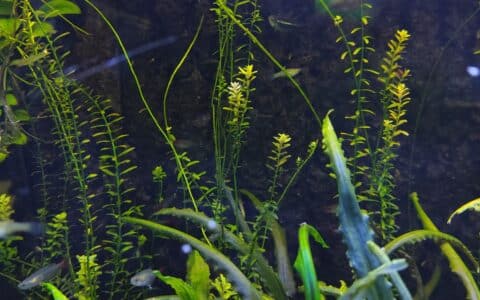
Silk-style aquarium plants provide cover and a planted appearance without needing light or nutrients for growth. They can be useful in a fish-only aquarium, but they still need cleaning and inspection. “Artificial” does not mean sterile, indestructible or safe regardless of design.
What silk plants offer
They keep their basic shape without pruning and can provide visual barriers where a live plant would receive too little light. They also avoid the problem of a fish repeatedly uprooting a living stem plant.
The material sold as “silk” is often synthetic fabric combined with plastic supports. Compare the actual construction rather than assuming the name describes natural silk or a consistently soft product.
Aqueon’s artificial plant guide discusses using decorations for cover and layout. Leave swimming space and choose plants proportional to the fish rather than filling every opening.
Silk, plastic or live plants?
| Option | Main advantage | Main care requirement |
|---|---|---|
| Soft fabric leaves | Flexible cover and movement | Inspect for fraying, exposed supports and trapped debris |
| Molded plastic plants | Often straightforward to wipe clean | Check rigid tips, seams and surface wear |
| Live plants | Growth, nutrient uptake and a changing habitat | Match species to light, nutrients and livestock |
No category is automatically the cheapest or safest. Some live low-light plants grow without injected CO2 or nutrient-rich soil. Equally, a well-chosen artificial plant can provide useful cover when live planting is impractical.
Check the whole decoration for safety
Use products intended for continuous aquarium immersion. Inspect leaf tips, stems, bases, joints and any internal supports. Soft leaves do not compensate for a sharp plastic stem or a wire exposed by wear.
Avoid loops, narrow openings or dense tangles that can catch fins or trap a fish. For a betta, provide smooth cover and access to the surface; decoration choice does not make a bowl adequate housing.
Remove a plant if it frays, exposes metal, sheds material or develops a deteriorating coating. Do not assume a fish cannot bite off or swallow part of an artificial plant.
Cleaning and biosecurity
Rinse new decorations according to their instructions. During maintenance, lift them out carefully and remove algae and debris with a dedicated soft tool. Avoid soap and household sprays.
Use only a manufacturer-approved cleaning or disinfection method. Heat, bleach and acids are not compatible with every fabric, dye or adhesive. Rinse and prepare the item as directed before reuse.
An artificial plant transferred from another aquarium can carry organisms on its surface. It does not eliminate the need for biosecurity, and a new retail package is not a guarantee of sterility.
Keep normal tank maintenance
Artificial plants do not photosynthesize or take up nitrate through growth. They also collect waste and support surface biofilms. Maintain filtration, gas exchange, testing and partial water changes rather than treating a decorative layout as maintenance-free.