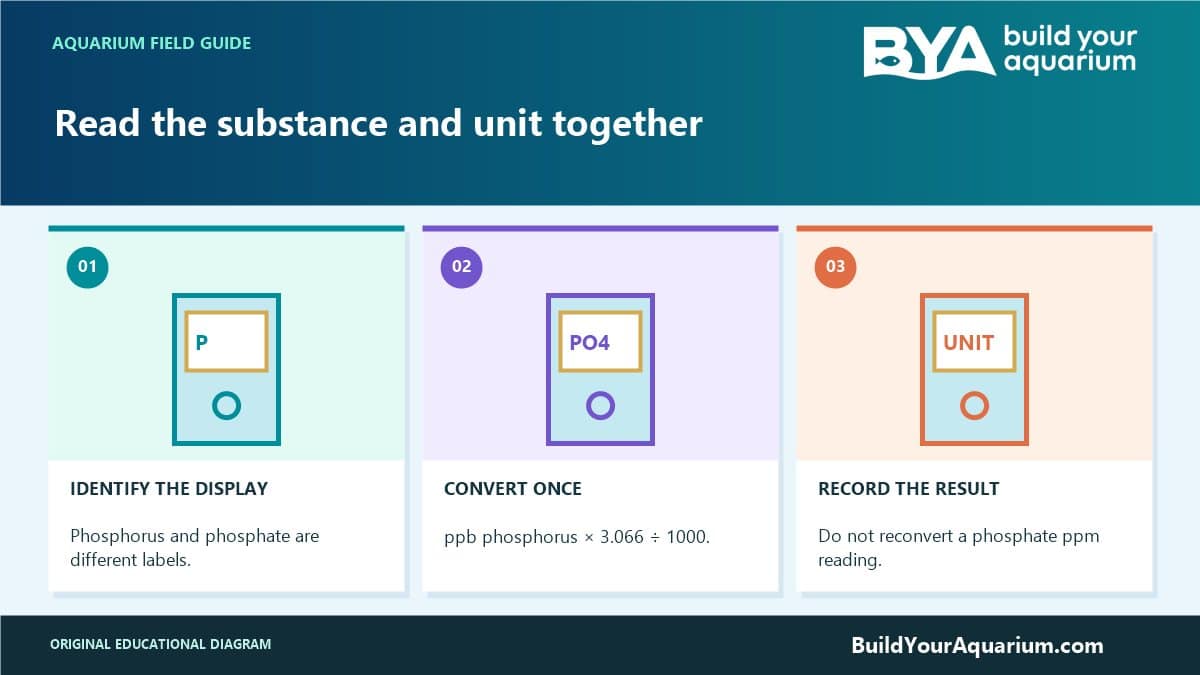
A reef keeper reports “phosphate is twenty,” but the instrument actually displays phosphorus in parts per billion. Before comparing that value with someone else’s phosphate target, identify both the substance and the unit.
A missing unit can make a normal-looking discussion lead to a very different interpretation.
Use the conversion for the actual display
Hanna Instruments gives this conversion for ppb phosphorus to ppm phosphate: multiply by 3.066, then divide by 1,000.
For example, 20 ppb phosphorus corresponds to 0.06132 ppm phosphate, usually recorded as about 0.061 ppm with appropriate regard for the instrument’s limits. It does not mean 20 ppm phosphate.
If the instrument already displays phosphate in ppm, do not apply the conversion again. Check the exact model name and manual; visually similar instruments can report different quantities.
Preserve the original measurement
Write down the device, displayed number and displayed unit before calculating. Keep the converted value alongside it so a later comparison can be checked.
Do not describe a result with more confidence than the instrument’s stated resolution and accuracy permit. A calculated string of decimal places does not create additional measurement certainty.
Our water-parameter guide explains why a number needs its method and context.
Interpret before changing the aquarium
Verify an unexpected result with correct sample preparation and suitable reagents. Compare it with recent records and the needs of the system before changing phosphate-removal media or adding nutrients.
The reef reactor guide covers equipment differences. Choosing a reactor is a later decision; the first task is knowing whether the number in front of you is phosphorus or phosphate, and ppb or ppm.