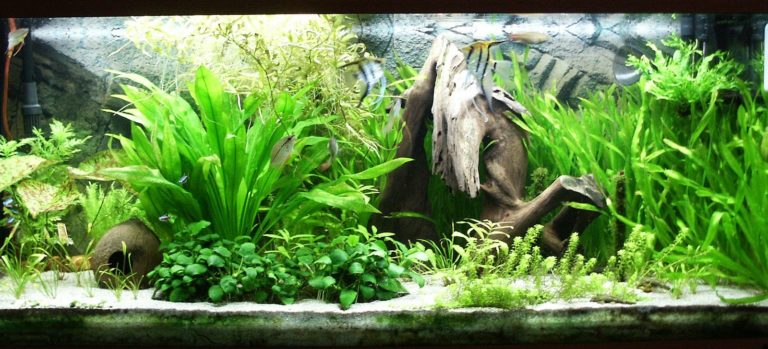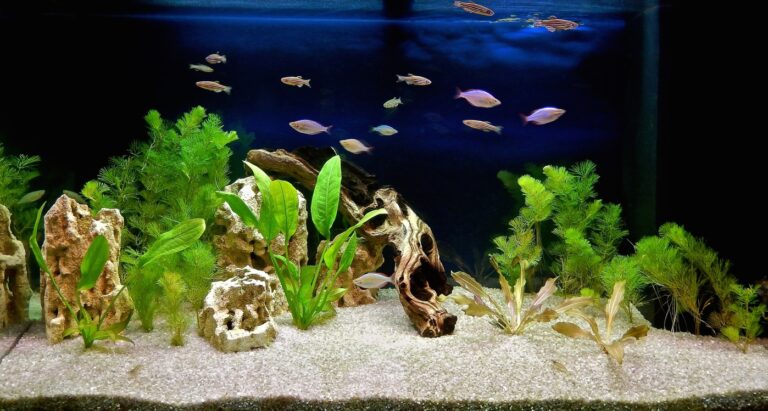

Subwassertang, also written Süsswassertang, forms soft green cushions in freshwater aquariums. It resembles a liverwort or loose moss, but research identifies the familiar aquarium form as a fern gametophyte associated with Lomariopsis.
What the plant actually is
A 2009 molecular study by Li and colleagues placed the plant within Lomariopsis, close to L. lineata. This supports the fern identification rather than the older “Pellia moss” label.
A gametophyte is a normal generation in a fern’s life cycle, not an incomplete or defective organism by definition. The study does not justify claims that every aquarium portion is genetically identical or that an assumed genetic fault prevents all further development.
Placement and propagation
Rest a small portion in a sheltered place, or retain it gently against suitable hardscape. Do not bury it deeply in substrate. Avoid tight bindings that crush the tissue or leave loops that can trap animals.
Divide healthy growth into smaller pieces when propagating. Handle it carefully: fragments can lodge around the aquarium and grow in places you did not intend. Collect loose pieces during trimming rather than letting them enter a filter intake.
Subwassertang provides cover and grazing surfaces for cherry shrimp and small fry. It can also trap debris, so a thick cushion still needs gentle cleaning and thinning.
Light, growth and temperature
Low to moderate aquarium lighting is usually sufficient. Do not assume stronger light always improves growth; it can instead encourage algae on slow-growing tissue.
Buce Plant’s cultivation information describes slow-to-moderate growth, optional CO2 and a temperature range of about 20–26.5°C (68–80°F). It should not be described as universally fast-growing or unable to grow above 74°F.
Aquatic Arts also describes it as a slow-growing, low-light plant. Establishment and growth depend on conditions and the portion’s health, so leave time to assess new tissue instead of moving it repeatedly.
Nutrition and routine care
Provide adequate nutrients without assuming every aquarium needs the same fertilizer dose. A lightly stocked tank may supply less than a heavily fed one, and excess dosing is not a substitute for identifying a deficiency.
Injected CO2 is optional. Liquid carbon products are different chemicals, not bottled CO2 gas; check plant compatibility and avoid overdosing or untested spot treatments.
Maintain gentle circulation that limits debris accumulation without tearing the plant apart. If growth browns, inspect shading, trapped waste, water conditions and recently added products. Remove deteriorating tissue and observe fresh growth.
Plants do not guarantee safe ammonia or nitrite levels. Continue normal filtration, testing and maintenance. Compare Java moss if you want a different texture, or our low-light plant guide for other options.
Image Credit – Rǫgn, CC BY-SA 4.0, via Wikimedia Commons