A saltwater aquarium budget needs two totals: the initial setup and the monthly running cost. Tank size, livestock, local electricity and water prices, and the type of reef you intend to keep determine both. A useful estimate lists quantities and unit prices rather than promising that every marine aquarium is only slightly more expensive than freshwater.
Separate startup purchases from ongoing costs
Price the tank and rated stand, filtration, circulation, heater or cooling, appropriate light, lid, rock or biological media, substrate if used, salt, water preparation, measuring equipment and quarantine supplies. Check what a packaged system actually includes before comparing it with a bare aquarium.
Buy lighting for the intended animals. Fish-only systems and demanding photosymbiotic corals have different needs. As one dated US price reference, a ReefLED G2 60 fixture was listed at $289 when checked on November 6, 2026, with mounting hardware sold separately. This is a product example, not a required purchase or a complete lighting budget.
Calculate salt and water use
Use marine salt mix, not plain freshwater aquarium salt. Compare cost per gallon mixed at your target salinity, including delivery. Advertised bucket yield may be based on a different salinity, so confirm the label.
For another US reference checked November 6, 2026, a nominal 160-gallon Instant Ocean bucket was listed at $79.99. That is approximately $0.50 per advertised gallon before tax and shipping, not the total cost of replacement seawater.
A 50-gallon system changing five gallons four times in a month would use 20 gallons of new seawater. At that nominal salt cost, the salt component is about $10. Add purchased purified water, or RO/DI source water, wastewater, filters and resin if producing it yourself.
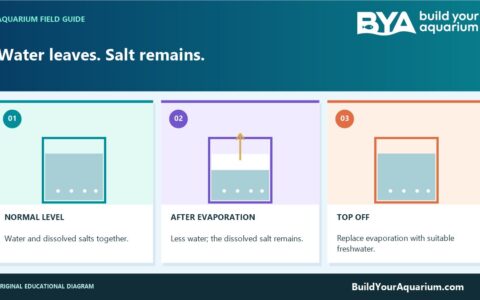
Evaporation top-off normally uses suitable freshwater because the salt remains behind. Do not budget or perform routine top-off as though it required another batch of saltwater.
Calculate electricity from actual equipment use
Use watts ÷ 1,000 × operating hours × your electricity price per kWh. A heater cycles rather than necessarily running continuously; seasonal room temperature can change its cost substantially.
| Illustrative 30-day example | Energy | Cost at $0.20/kWh |
|---|---|---|
| 40 W of pumps running continuously | 28.8 kWh | $5.76 |
| 60 W light operating eight hours daily | 14.4 kWh | $2.88 |
| 100 W heater actually on four hours daily | 12 kWh | $2.40 |
| Total for these three assumptions | 55.2 kWh | $11.04 |
This is arithmetic using stated assumptions, not a measured aquarium bill. Add skimmers, UV, fans, chillers, dosing equipment and other devices if present. Use a power meter where practical.
Include consumables and animal-specific needs
Allow for suitable food, test reagents, salinity calibration fluid, filter materials and replacement parts. A reliable salinity instrument can be a hydrometer, refractometer or suitable electronic meter; it does not have to be one particular type.
Coral supplementation depends on measured consumption, not an automatic monthly purchase of every trace element. A protein skimmer can be useful, but its purchase does not remove all other water-quality costs.
Specialist animals add feeding and care obligations. For example, seahorses need a dependable feeding routine, while a growing stony-coral collection may require more testing and mineral replacement.
Keep a reserve and compare complete totals
Include quarantine, replacement equipment and an emergency reserve before buying livestock. Live rock or live sand does not guarantee an instantly cycled, pest-free aquarium. Used equipment may save money but needs condition and completeness checks.
In the example above, salt plus the three assumed electrical loads total about $21 per month. That excludes water, food, tests, media, livestock, tax, shipping and equipment replacement. Build your own complete monthly figure from the intended system, then check whether the ongoing maintenance fits the budget.